
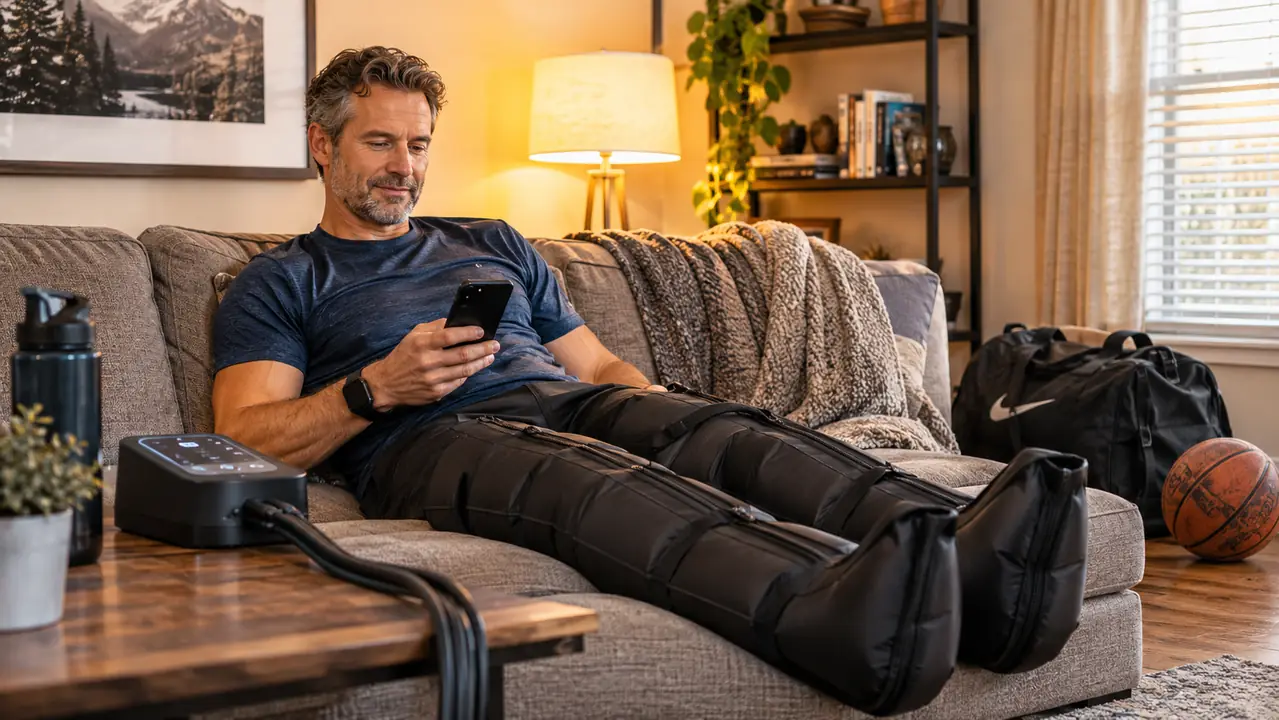
Five months ago I finally bought a set of compression boots. Not because I had an injury. Because last winter I noticed a pattern I could not unsee. I would play men's league basketball on Tuesday night, wake up Wednesday feeling every one of my 46 years, stay sore through Thursday, and feel normal again around Friday, right in time to do it all over. I am 6 feet, about 205 pounds, and I caught four years of college baseball, so my knees and hips have opinions about stairs. The Hyperice Normatec 3 legs were the biggest single purchase I have made for recovery, bigger than the massage gun, bigger than anything sitting in my garage. Before that, the only compression I had ever worn was a friend's pair of sleeves I zipped on in a hotel parking lot on a road trip.
Here is the short answer. If your problem is soreness that hangs around for two or three days and you will actually sit still for 30 minutes at night, the boots do more and they do it without asking anything of you. If your problem is that you are on your feet all day and you want compression while you are already moving, sleeves are the cheaper, simpler answer and they will get used more often. I own the boots. I have never owned sleeves. That is not the same as saying the boots are right for you.
| Hyperice Normatec 3 | Compression Sleeves | |
|---|---|---|
| Coverage | Feet up through the thigh, 5 overlapping zones | Calf or full leg in one continuous squeeze, nothing overlapping |
| Pressure settings | 7 levels of compression plus ZoneBoost | One fixed squeeze, whatever the fabric gives you |
| How the squeeze feels | Sequenced, traveling, almost like a cuff rolling up the leg | A constant hug you stop noticing after a few minutes |
| Can you move while wearing it | No. You are tethered to a wall outlet | Yes. Walk the bleachers, drive, stretch, warm up |
| Where it lives | On the floor next to a couch, 13.45 pounds, needs an outlet | Gym bag, glove box, desk drawer |
| Time cost | 30 minutes parked, no multitasking beyond television | Folded into time you were already spending on your feet |
| Sizing forgiveness | Standard fits a 31 to 35 inch inseam, 30 inch max thigh | Stretch fabric, more forgiving across body shapes |
| Entry commitment | The largest line item in my recovery setup | The smallest way into compression by a wide margin |
| Setup | Unzip, plug in, pick a level | Pull on, go |
| Best for | Evening recovery at home after a hard session | Daytime compression while you are already moving |
Where the Normatec 3 Wins
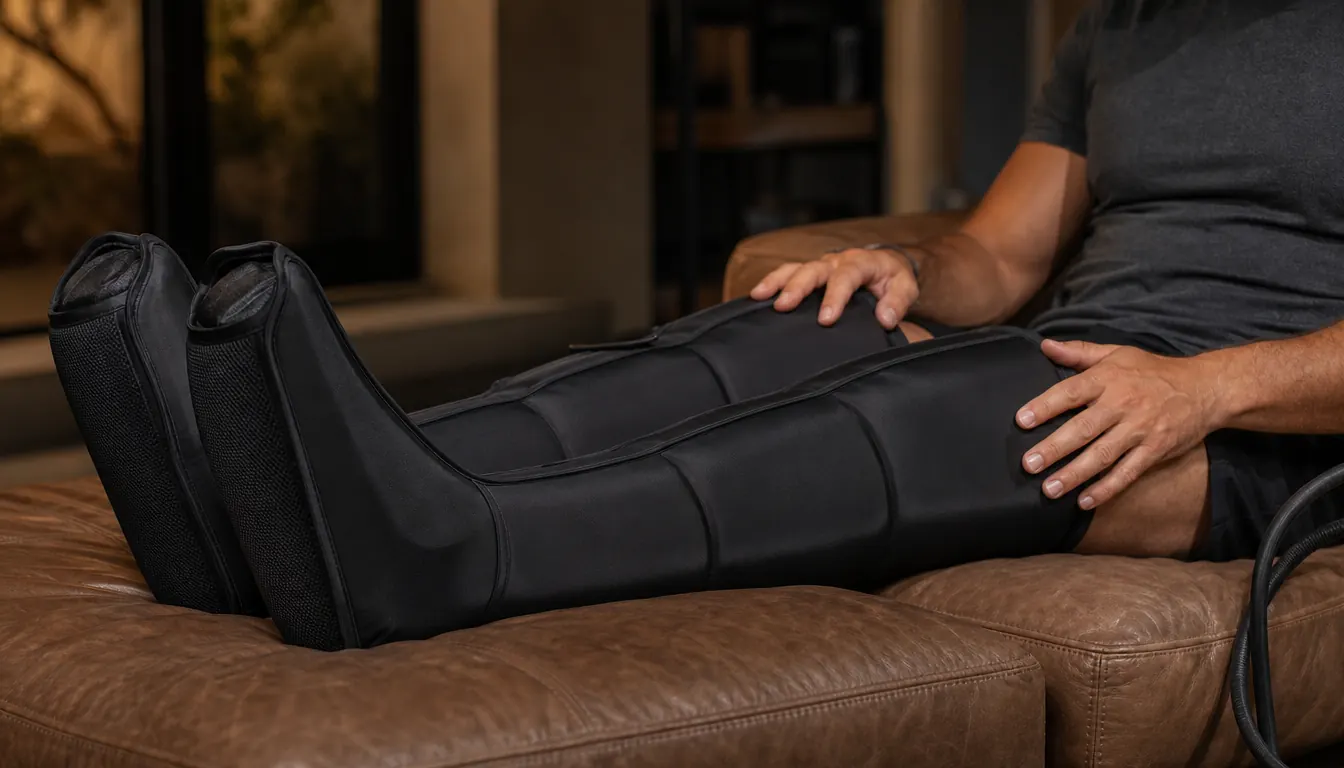
The thing sleeves cannot copy is the sequence. The Hyperice Normatec 3 works from the feet up through 5 overlapping zones, and the squeeze travels instead of clamping down everywhere at once. My first night I expected a big hug and got something closer to a slow wave moving up my calf, then past my knee, then into my thigh. By the time it reached the top I had stopped bracing against it. That travel is most of the reason I can fall asleep in the middle of a session, which I have done more than once.
There are 7 levels of compression on the unit I have, plus ZoneBoost when one area needs more than the rest. On a normal Tuesday I run level 4 or 5. After a softball doubleheader on a Saturday in April, I go to 6. Level 7 exists and I have used it twice, and both times it felt like the couch was sitting on me instead of the other way around. A sleeve gives you one pressure and no vote. The first week I owned the boots I ran level 6 every single night because I figured more pressure had to mean more recovery, and by Thursday my calves felt worked over instead of loosened up. I dropped back to 4 and stayed there a month before I crept up again. It took me about ten days to understand that the level is not a scoreboard.
The last advantage is not a feature at all. It is that the boots force you to stop. I cannot carry laundry up the stairs or fold towels while a sleeve does its work, but I can absolutely clip the boots on, put my feet up, and stay there for half an hour, because the cord makes the decision for me. Some nights that is the only 30 minutes of my day that is not spent doing something for somebody else.
Where Compression Sleeves Win
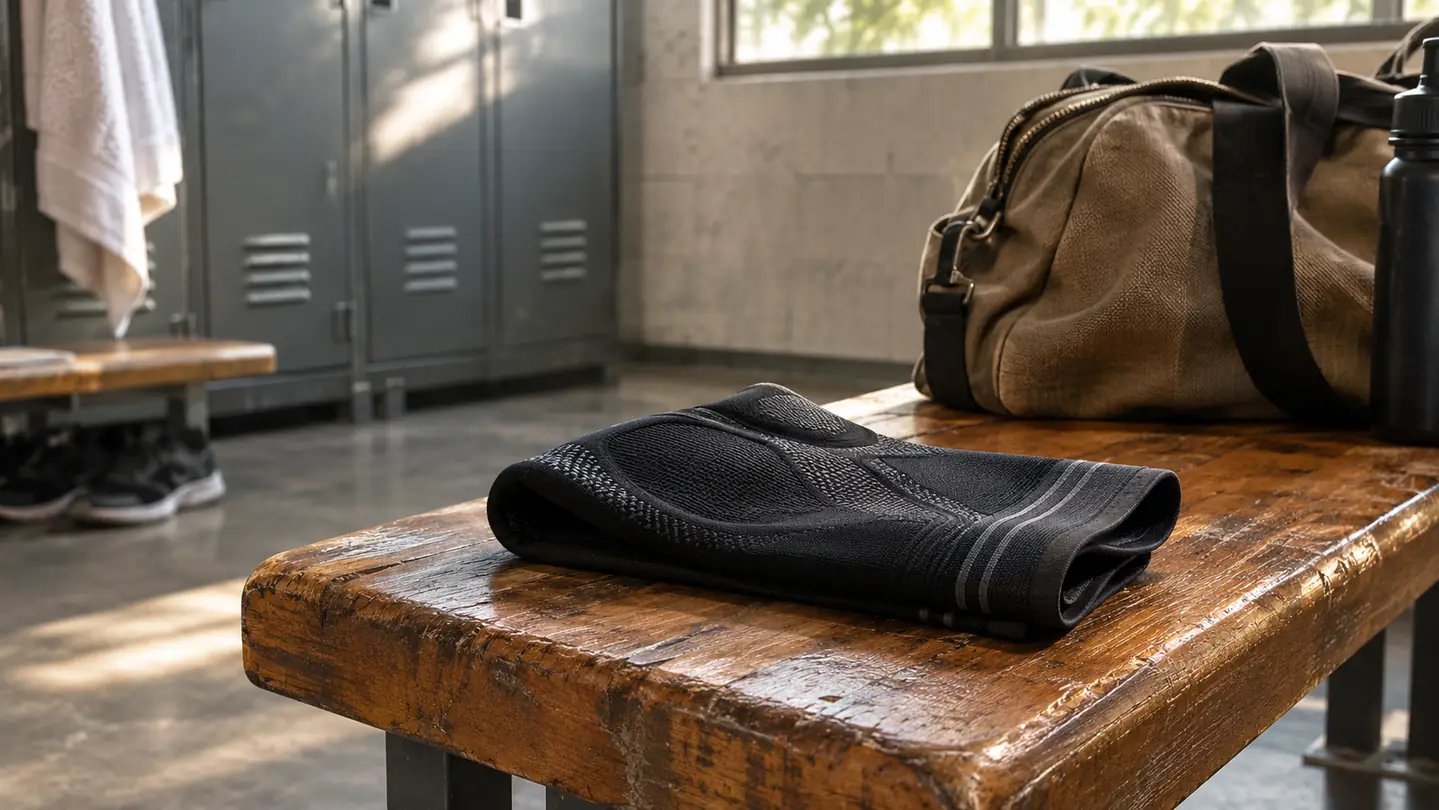
Sleeves win the argument that matters most to a lot of people: they get used. A sleeve goes on and you keep living. You wear it under pants at the field house, you wear it driving home from a road game, you wear it while you are standing in the bleachers watching your kid's travel team play a doubleheader in June heat. Try any of that with a corded unit that weighs 13.45 pounds and needs a wall outlet. I tried a friend's pair once on a six hour drive back from a district game in the fall, and the thing I remember is not the squeeze at all. It is that I forgot I had them on somewhere outside Waxahachie, and my right calf was not barking at me when I climbed out of the truck in the school lot. That is the whole case for sleeves in one sentence.
They also win on simplicity and on the price of walking in the door. There is nothing to plug in, nothing to charge, nothing to break, and the fabric is far more forgiving on sizing than a fixed boot with a stated inseam range and a maximum thigh circumference. If you are 22 and playing three sports and living out of a duffel bag, sleeves are the honest first buy. If you are a parent buying for a high school kid, same answer.
If you are going to be parked on the couch anyway, get the bigger tool
The Normatec 3 is for the nights when the television is already on and your legs are already done. Seven levels of compression, 5 overlapping zones from foot to thigh, ZoneBoost for the tight spots. Standard size fits a 31 to 35 inch inseam and a thigh up to 30 inches.
Amazon Check Today's Price on Amazon →What Five Months of Boots on the Couch Looked Like
My routine is boring, which is the point. Two or three evenings a week, usually Tuesday after basketball and Saturday after a doubleheader, I sit on the living room couch, unzip the boots, plug the cord into the outlet behind the end table, and run 30 minutes. My wife Dana has learned that the machine noise means I am not getting up to do anything, so she plans around it. The unit stays on the floor beside the couch. It does not travel. It has never been in the truck except the day I brought it home. The system is down to a routine now. Boots on the floor, cord run behind the end table so nobody trips over it, remote on the armrest, phone face down. Dana's show starts at 8 and I am usually running by 8:10. If I miss that window I skip it, because 10:30 at night is not an hour when I am going to sit still for half an hour no matter how good my intentions were at dinner.
What changed is smaller than the marketing and bigger than nothing. The soreness that used to run Wednesday through Thursday now mostly ends by Wednesday afternoon. I am not bouncing out of bed. I am not 25 again. But the two-day tax on my week went down to about a day, and on a schedule where I coach, teach, and still play, that is the whole difference.
The boots did not turn me back into a 25-year-old. They knocked two days of soreness down to a morning, and that is the honest version of the review.
The tradeoffs are real. You are tethered to a wall, so the machine is useless at a tournament. The listing says it is not water resistant, and I believe it, so I do not put them on straight out of the shower. And it does nothing for the thing that causes most of my soreness, which is skipping a warmup because I was late getting the field set up. If you will not sit still for 30 minutes, do not buy the boots. Buy sleeves and be honest with yourself.
The Sizing Detail That Decides It
The standard size is built for a 31 to 35 inch inseam with a maximum thigh circumference of 30 inches. I am a 32 inch inseam, so I am near the short end of that range, and the boots still fit correctly with room in the thigh panel. If you are outside that window, this is not a buy-it-and-see item. Measure before you order, and measure your thigh where it is thickest, not where it feels comfortable.
Sleeves are more forgiving here, and that matters for anyone buying for a teenager who is still growing. A fabric sleeve that stretches will fit a kid in March and still fit him in October. The Hyperice boots are a grown-up purchase, sized for a grown-up leg, and they will not adjust to a growth spurt.
The Question I Get From Parents and Assistant Coaches
I get asked this constantly at the field house, usually by a parent whose 15-year-old is playing four games in three days. My answer is always sleeves first. A kid is not going to sit on a couch for 30 minutes after a travel tournament. He is going to eat something standing up and fall asleep in the truck on the way home. A sleeve goes on in the dugout and works while he is doing what he was going to do anyway. Last spring I watched a kid ice his knee between games of a Saturday doubleheader and then go 0-for-3 in the second game because he was stiff as a board. Nobody in that dugout had 30 minutes to give a machine, and even if they had, he was not going to take them. He wanted a hot dog and ten minutes of quiet.
The other half of that answer is the part people do not want: neither tool is a treatment. If something hurts in a way that is sharp, swollen, or still there after a week, see a doctor. I am an assistant athletic director who played some baseball, not a trainer, not a physical therapist, and not a doctor. Boots are a way to feel better after work you chose to do. They are not a diagnosis and they are not a substitute for one.
What I'd Tell a 30-Year-Old Ballplayer
If you are still playing three or four nights a week and the thing holding you back is how you feel the day after, and you have a couch and an outlet and no kids climbing on you at 8 p.m., get the boots. The difference between 7 levels of sequenced compression and one fixed squeeze is not something you can fully explain to somebody. You feel it the first night and you stop wondering why the pros are sitting there in those things.
If you travel with a team, if you are in a truck half your life, if you are the guy who does not sit down until the lights are off, spend small and buy sleeves. A tool you use five times a week beats a better tool you use twice a month, every time.
Who Should Buy Which
Buy the Hyperice Normatec 3 if you have a fixed spot in the house where you actually sit down at night, if you are inside the 31 to 35 inch inseam range, and if two days of soreness after a hard session is the specific thing you want to shrink. Buy it if you are the person who will treat those 30 minutes as part of the routine and not as a treat. Mine is the only recovery purchase I have made that I use on a schedule, because the cord does not let me pretend I am multitasking.
Buy compression sleeves instead if you want help during activity rather than after it, if your recovery happens in a dugout or a dugout parking lot, if you are buying for a teenager, or if you are not yet sure compression is worth real commitment. Sleeves are the cheap test of whether compression works for your body. If it does and you find yourself wishing you could get more pressure, in more zones, while you are parked anyway, that is your signal to move up to the boots.
The bigger tool, for the nights you were going to sit down anyway
Seven levels of compression, 5 overlapping zones from foot to thigh, ZoneBoost for the tight spots. Standard size covers a 31 to 35 inch inseam and a thigh up to 30 inches. Mine live beside the couch, which is the only reason they get used five months in.
Amazon Check Today's Price on Amazon →