
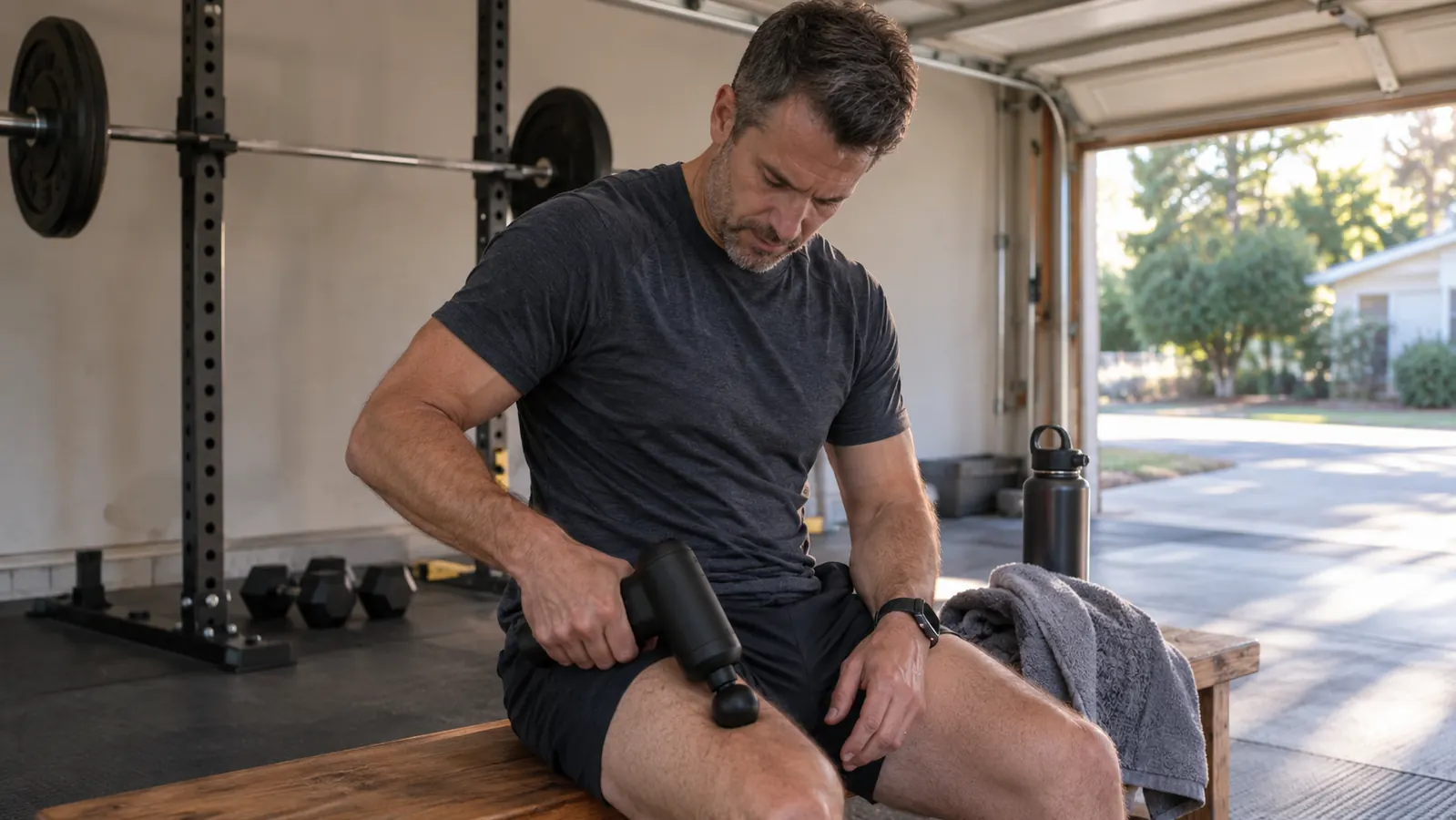
Last February I came in from Tuesday night basketball, sat down on the garage bench to untie my shoes, and seriously considered sleeping there. I am 46, six feet, about 205 pounds, and I caught four years of college baseball, so my knees and hips have been filing complaints since roughly 2004. But this was different. Every Tuesday for about six weeks I played, then spent Wednesday and Thursday walking like a man twice my age. Nothing was torn. Nothing swelled up. My right hamstring had tightened on me for years, and now my calves and my quads were joining the protest.
I am not a doctor, and I am not going to pretend to be one here. I am an assistant athletic director at a public high school outside Fort Worth, and I still play men's league basketball, some Saturday pickup, and softball in the spring and fall. So when the soreness started lasting three days instead of one, I ignored it for a month and then bought a TheraGun Prime (6th Gen). That was about ten months ago, with my own money, and it is the first and only massage gun I have ever owned. This is what that purchase actually did.
The Quick Verdict
Ten months in, the TheraGun Prime is the reason I can play twice a week at 46 without writing off the next morning. It is not a cure for anything, and it is heavier in the hand than I expected, but it rides in my gym bag and it gets used.
Amazon Check Today's Price →The gun that got me off the garage bench on Wednesday mornings
Five speeds, two attachments, about two hours of battery. One button, nothing to pair, nothing to update. It is the only recovery tool I own that actually leaves the garage.
Amazon Check Today's Price on Amazon →How I've Used It
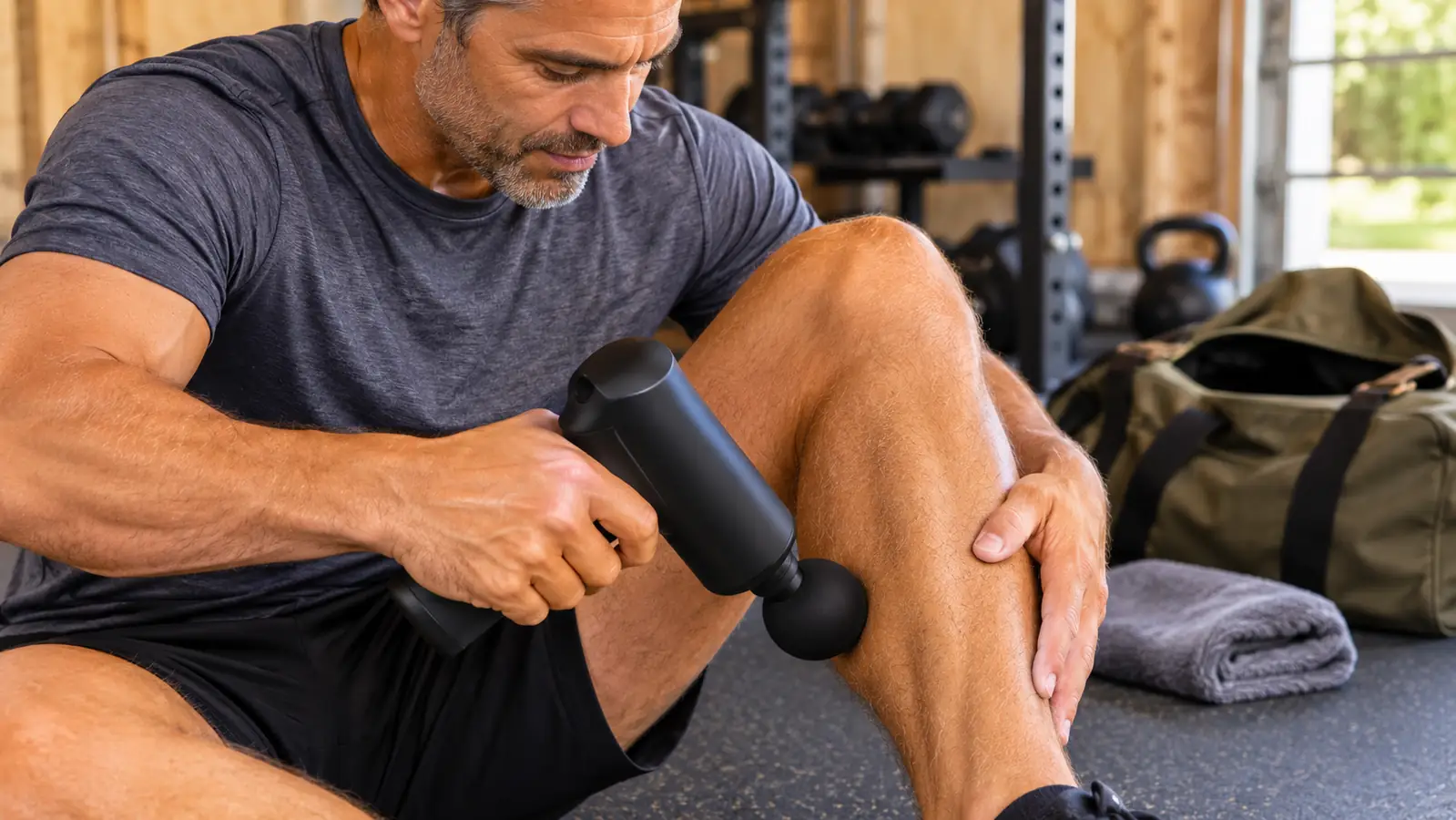
My routine is boring and that is the point. After Tuesday basketball I sit on the bench in the garage, turn the Prime on, and work calves, quads and shoulders at roughly one to two minutes per muscle. Same thing after a Saturday morning pickup game or a garage lift. I do not run it over my knees or my lower back, because nobody ever showed me how to do that safely and I am not going to guess at it on my own spine. The whole session takes about eight minutes, and then I go eat something.
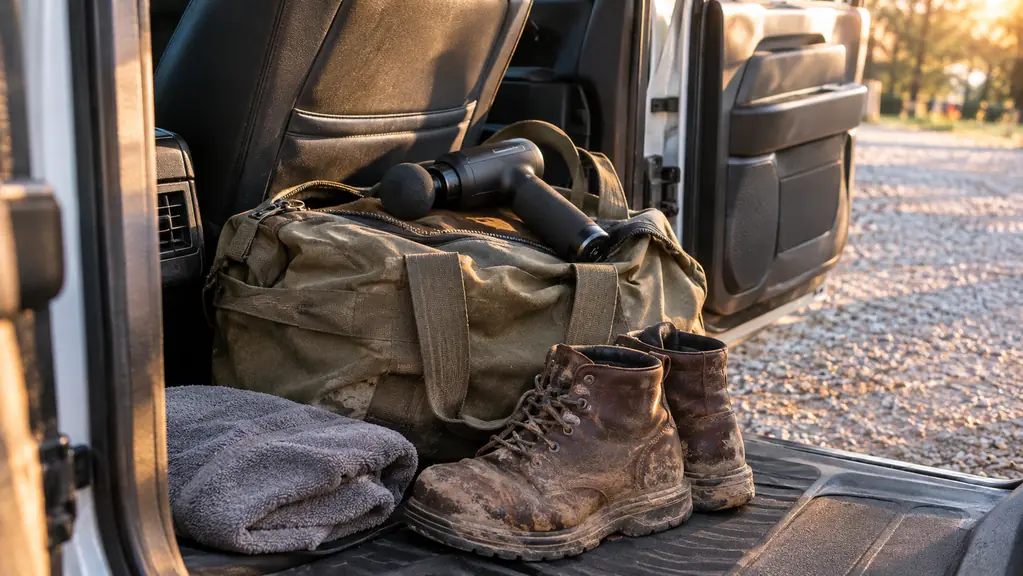
The gun lives in my gym bag, which rides behind the seat of my gray 2018 Ford F-150. That was the deciding factor over a bigger unit, honestly. Any recovery tool that stays in the garage gets used about twice a month. Something that comes with me gets used four or five times a week, including in the parking lot after a game while I am still in my shorts and one of our assistant principals is giving me a look through the windshield.
The first two weeks I overdid it. I ran it hard on my right hamstring, the tight one since college, and it felt bruised the next day. I backed off to the lower speeds and shorter passes, and that is what I have done ever since. The thing does not need much pressure from you and it does not need much time. That is a lesson I paid for with a sore leg, and it is the single most useful thing I can tell you about owning one.
What the Spec Sheet Means Once It's in Your Hands
The Prime has five speeds and I use three of them. Speed one or two for shoulders and the area around my shoulder blades. Speed three for calves after a game. Speed four or five only on the quad, and only for a short pass, because anything higher on a cranky hamstring is a mistake I already made once. Five is more than I need, but I would rather have headroom than run out of it.
The interface is one button and a set of LED indicators. That is the whole thing. Nothing to pair, nothing to update, nothing to figure out at 9:45 at night when my calves hurt and my patience is gone. The indicators also show how much pressure you are applying, which sounds like a gimmick until you catch yourself leaning your whole body weight into a device the size of a power drill.
The motor is the part I would not have appreciated on paper. It holds its speed when you push into a muscle instead of bogging down and stalling, which is exactly what the cheap units at the sporting goods store do. The listing claims up to two hours of battery, and I get through a full week of my usage before I think about charging it. Charging takes about an hour when it finally needs it. The unit weighs 3.6 pounds and measures about 10.89 by 9.07 by 3.05 inches, so it drops into the main compartment of a normal duffel with room left for shoes.
Ten Months In: What Actually Changed
Here is the honest version. The TheraGun Prime did not fix my knees and it did not make me 30 again. What changed is the Wednesday. Last winter I was sore for two or three days after every Tuesday game. Now I am usually stiff for a few hours and roughly normal by Wednesday afternoon. That is not a medical outcome, it is a schedule outcome. I can play twice a week at 46 without losing the next day to it, and that is worth a lot to a guy who is not ready to be a spectator yet.
The second change is smaller. My right hamstring used to announce itself during the first sprint of a softball warmup. That still happens some, but less. Whether that is the gun, the loop bands I started using before every game, or just the fact that I am finally doing something instead of nothing, I cannot tell you. I am not going to sit here and claim I ran a controlled study on myself in a garage in Tarrant County.
What I can tell you is that I still use it ten months later, which is more than I can say for most of the recovery gear I have bought. There is a wire shelf by the door to the house where that stuff goes to be forgotten. The Prime is not on that shelf. It is in the truck, and the truck is where my good intentions actually survive contact with a Tuesday night.
The Two Attachments, and Which One I Reach For
It comes with two attachments and I use both. One gets the big muscles, quads and calves, where I want the pressure spread out so I can move it around without thinking about it. The other is what I reach for on the shoulders, where the first one feels like it is bouncing off bone rather than getting into anything. On paper, two sounds thin next to the kits with six heads in a molded case. In practice I have never once wished I had a third.
If you are the kind of person who wants to experiment with a different head for every body part, this is not that device. If you want to grab it, hit a calf for ninety seconds, and put it down, two is plenty. I would rather own two I know than six I have to think about at ten at night.
Where It Comes Up Short
At 3.6 pounds it is not light. Holding it up on the back of a shoulder for two straight minutes gets old, and I have caught myself switching hands halfway through. There is no way around that except shorter passes and using your other arm, and I would rather tell you that now than have you find out in the middle of it.
It is also louder at the top two speeds than I expected. Not a dealbreaker, not something the neighbors will call about, but if you were planning to use it in a quiet living room while somebody watches television, expect a comment from the couch. The lower speeds are fine.
And the honest ceiling on the whole thing: it is a recovery tool, not a treatment. It does not replace a doctor, a physical therapist, or an actual diagnosis. If something is sharp, or lasts more than a couple of weeks, or wakes you up at night, put the gun down and go get it looked at. I mean that. I have watched enough kids in our training room try to rub out a real injury in time for a playoff game and lose the rest of the season for it instead.
What I Compared It To Before Buying
I was already rolling before I bought the gun. I have had a 13-inch TriggerPoint GRID foam roller for about three years, and I still use it most mornings on the garage mat for hamstrings, the IT band area, and my upper back. Rolling and the gun do different jobs for me. The roller is the slow, uncomfortable, whole-leg thing I do before I lift. The gun is what I do after a game, when I want to hit one specific spot on one specific calf and get on with my night.
I also used a teammate's massage stick in the dugout once and did not care for it. It is cheap and it works if you put in the effort, but you are the motor. When your shoulders are the thing that is tired, that is a bad trade.
The other recovery purchase I have made is the Hyperice Normatec 3 legs, which I bought about five months ago and use two or three evenings a week on the living room couch. That is a different device with a different job, and if you can only do one, I would put the gun first because it travels. The boots live at the couch. The Prime lives in the truck. The truck wins.
What I Liked
- Holds its speed under pressure instead of stalling when I lean into a calf
- One button and LED indicators, so there is nothing to pair or think about at night
- About two hours of battery covers more than a week of my usage
- Compact enough to live in a gym bag, which is the only reason I use it consistently
Where It Falls Short
- 3.6 pounds is noticeable when you are holding it overhead on a shoulder
- Louder at the top two speeds than I expected
- Two attachments is enough for me, but it is not a full kit
- Not a purchase to make on a whim unless you know you will actually use it
Last winter I was sore for two or three days after every Tuesday game. Now I am stiff for a few hours and roughly normal by Wednesday afternoon.
Who This Is For
This is for the guy in his 30s, 40s or 50s who still plays something and is finding out that the recovery is harder than the game. Men's league basketball, softball, pickup soccer, a Saturday morning run, coaching your kid's team and then demonstrating a drill you had no business demonstrating. If your soreness is outlasting the activity by a day or two, and you want a tool you can throw in a bag and use in eight minutes, this one does that job well. It is also a reasonable pick for a parent who is driving to tournaments and has thirty minutes in a parking lot between games.
It fits best if you already sleep, eat and warm up like somebody who intends to keep playing. The gun is a supplement to that, not a substitute for it. I noticed the biggest difference once I paired it with the warmup bands and stopped treating a Tuesday game like I was still 22.
Who Should Skip It
Skip it if the device is going to sit on a shelf. This is the most common way people waste money on recovery gear, and I have done it myself with other purchases. If you are not going to carry it, do not buy it. Skip it too if you want a big kit with a head for every body part, or if you are shopping for something to treat an injury, because that is a conversation for a doctor and not for a product page.
And skip it if you already own a massage gun that works. Ten months in, I have not found a reason to upgrade from this one, and I would not expect you to either. The TheraGun Prime earns its place for me because it was the first one I bought and it solved the problem. If yours already solved yours, go spend the money on new shoes.
Ten months later it is still in my gym bag, and that is the whole review
Five speeds, two attachments, about two hours of battery, one button, 3.6 pounds. It solved a problem I had every Wednesday morning. Check the current price and see whether it fits what you actually need.
Amazon Check Today's Price on Amazon →