
Tuesday night men's league basketball is the best two hours of my week and the worst two days after it. I'm 46, six feet, about 205 pounds, and I play like a guy who caught four years of college baseball and has not fully accepted how long ago that was. By Wednesday morning my quads feel like somebody worked them over with a bat, and for two or three days I take stairs sideways like a man twice my age.
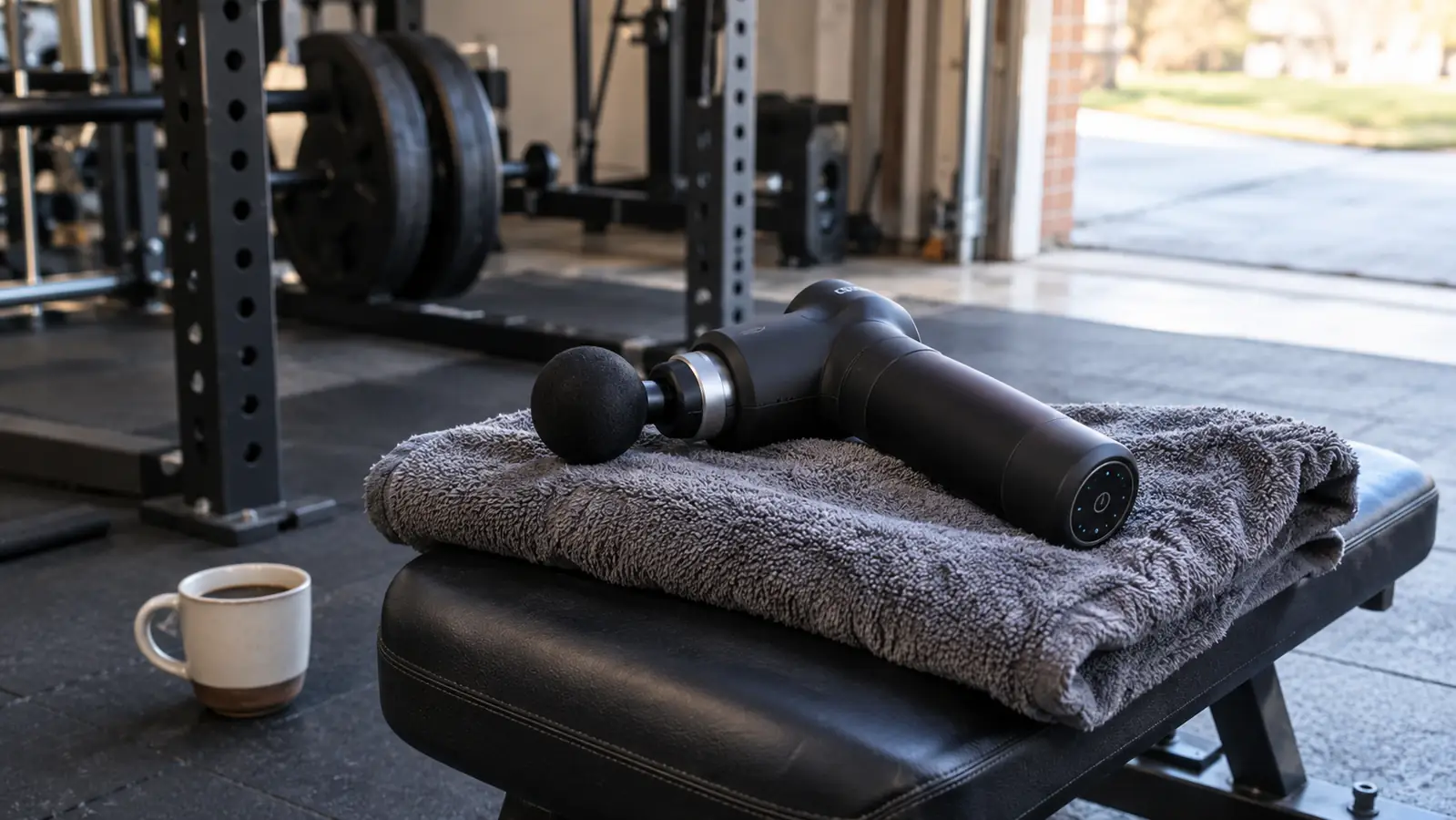
I tried the usual stuff. Stretching on the garage mat before bed. More water. A foam roller, which I still use most mornings. All of it helped around the edges and none of it changed the fact that I was sore on Wednesday, sore on Thursday, and half speed at Friday's lift. About ten months ago I bought a TheraGun Prime (6th Gen) with my own money. It is the first and only massage gun I have owned. It lives in my gym bag behind the seat of my truck, and what follows is exactly what I do with it on sore quads, not a cleaned-up version of it.
One Button, Five Speeds, Two Hours of Battery
I did not want a recovery tool with a menu. TheraGun Prime is one button, five speeds, two attachments, and enough charge that I go about a week between plug-ins. It is what comes out of my gym bag first on a Wednesday morning.
Amazon Check Today's Price on Amazon →Two Mistakes I Made First
I'll save you a couple of weeks. The first time I used it, I cranked it to the top speed and leaned into the sorest spot on my thigh until it felt like a punishment I had earned. That is not recovery. That is adding a fresh problem on top of the old one. A percussive gun is not something you win a fight with, and your leg does not get extra credit for how much it can take.
The second mistake was timing. I used it the minute I got home from the gym, then sat on the couch for an hour. The gun loosened things up a little and then nothing moved. Now I walk first and use the gun after, or use the gun and then walk. Either order works. The walking is the part that is not optional.
One more thing before the steps. I am not a doctor, a trainer or a physical therapist and I am not going to write like one. This is what works for me at 46 with a body that has some miles on it. If your pain is sharp, or swollen, or it is still there in a week, put the gun down and go see somebody who went to school for it.
The Five-Step Routine I Use on Sore Quads
Step 1: Walk ten minutes before you touch the gun
My Wednesday starts on my feet, not on the mat. Ten minutes of plain walking, around the block or up and down the driveway while my coffee goes cold on the tailgate. I am not chasing a heart rate. I am getting blood moving through tissue that sat still all night.
I started doing this because the first minute of the gun felt like it was bouncing off a brick instead of getting into the muscle. Warm tissue takes the work better. On the mornings I skip the walk and go straight to the gun, I end up pressing harder to feel like I am accomplishing something, and pressing harder is exactly what leaves me bruised.
Ten minutes is not a workout and it should not feel like one. If I am honest, this is the step I skip most often when I am running late, and it is the step whose absence I notice. Walking in, gun after. That is the whole rule.
Step 2: Start at speed 2 and stay there longer than feels useful
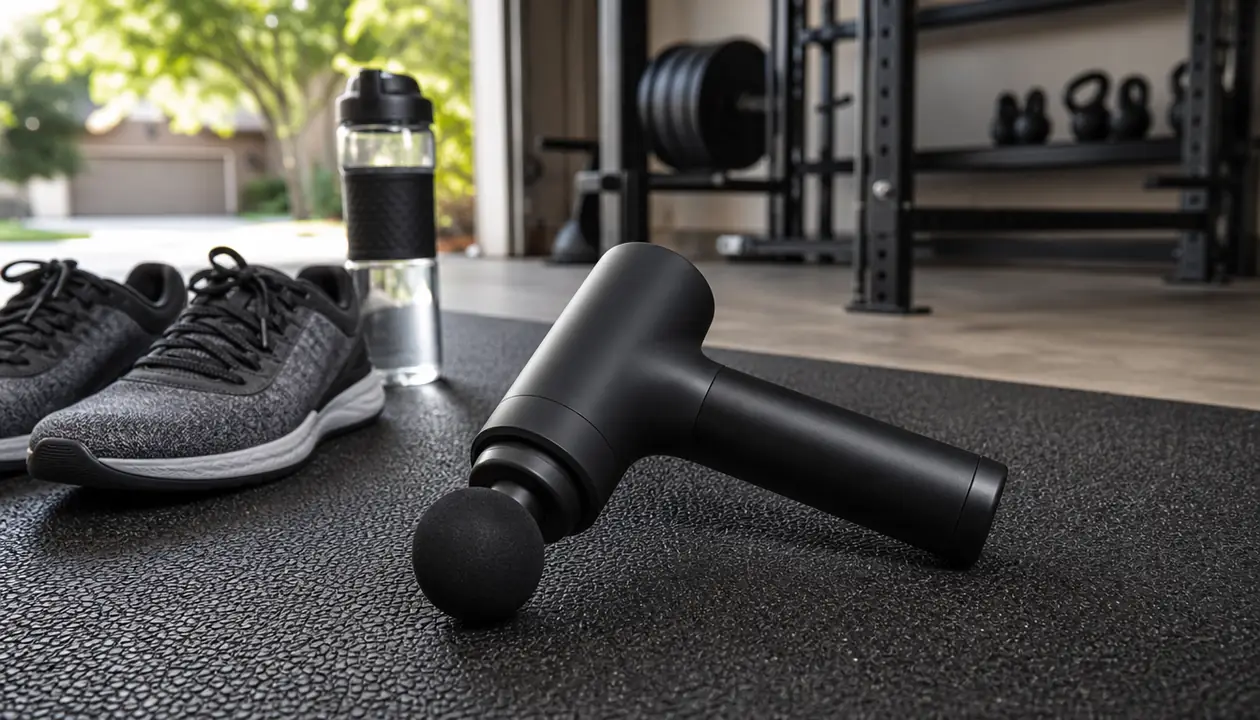
The Prime has five speeds and one button, with LED indicators that show where you are and how much pressure you are putting in. Speed 2 looks timid. It is not. I spend the first full minute on each quad at speed 2, light pressure, slow passes, letting the motor do the work instead of leaning on it.
This is where the adaptive motor earns its keep. It holds speed and power under pressure instead of stalling out, so you do not have to drive it into your leg to keep it moving. That is the difference between a tool that does the work and a tool that makes you do the work, and it matters when your hands are tired and your quads are already angry.
Every time I have jumped straight to speed 4 or 5, I have regretted it Wednesday afternoon and again on Thursday. The high speeds exist for a reason, and that reason is not a quad that is still mad at you from last night.
Step 3: Work the quad in lanes, not one spot
Sore quads after leg day usually are not one sore spot. My soreness sits in the outer sweep of the thigh and in a band about four inches above the knee. If I plant the gun on the single worst point and stay there, I get a hot, angry spot and the rest of the muscle is still tight.
So I work in lanes. Outer lane from just above the knee up toward the hip, maybe eight slow passes. Middle lane, eight passes. Inner lane, eight passes. The head only covers a small area of skin, so the passes are how you cover ground. I overlap each lane by half and keep the gun moving at a walking pace, never parked.
One exception. On the inner thigh, a few inches above the knee, I keep the pressure very light and only take a couple of passes. That area is not a place to get brave. Same with the front of the kneecap. There is no muscle there to work on, so there is nothing to gain and plenty to irritate.
Step 4: Cap it at two minutes per muscle
Four minutes total for both quads. That is it. The gun will run up to two hours on a charge and there is a real temptation to keep going because it feels good and because more feels like it must be better. It is not. Past a couple of minutes on one muscle I am not helping anything, I am just making the tissue irritated.
I use the same cap on calves and shoulders, which is what I actually bought the thing for in the first place. Calves get two minutes each after basketball. Shoulders get two minutes each after a lifting morning. My battery lasts about a week that way, and a full charge takes about an hour when I finally do plug it in.
If you want a timer, use the one on your phone. I set mine. Otherwise two minutes turns into six and I am standing there in my garage at 6:15 in the morning working on the same square inch of thigh like it owes me money.
Step 5: Swap attachments, then stretch slow
The Prime comes with two attachments. I do the bulk of the work with the first one, then swap for the last thirty seconds on each leg. The swap does not do anything magical. It changes the feel enough that I stop bracing, and I pay attention again instead of going through the motions.
Then I stretch, but not the way I used to. No bouncing, no trying to force my heel to my back pocket. I hold a standing quad stretch for about thirty seconds a side, then a hip flexor stretch on the mat for the same. The gun gets the muscle warm and a little softer, and the stretch is what keeps it there once I am dressed and out the door.
Four minutes with the gun on a Wednesday morning does more for my quads than twenty minutes of stretching ever did, and I stretched for twenty years.
The Other Recovery Gear I Have Tried
For quads specifically, a foam roller is the closest thing to a substitute and it is a distant second. I have had a TriggerPoint GRID for about three years and I roll most mornings, but I roll my hamstrings, the outside of my hip and my upper back. Rolling my own quads means folding up on the floor and dragging my body weight across a hard cylinder, which after a Tuesday game is about the last thing I want to do.
A massage stick is cheaper and I have used a teammate's in the dugout. It works fine on calves and it does nothing on the deeper part of a quad, because you can only press as hard as your own forearms allow. Compression sleeves I tried once on a road trip when a friend handed me a pair. They felt good for an hour and did nothing the next morning. The compression boots I own are a different animal and a much bigger purchase, and they are a couch-and-television thing, not a five-minute thing.
What Else Helps
The gun is the piece I reach for first, but it is not the whole answer and I would be lying if I said it was. The change that did the most for my Wednesdays was simply walking more. Ten minutes before the gun, another ten at lunch, and I am noticeably less stiff by evening than I used to be.
On the rough nights, after a Tuesday game or a Saturday doubleheader, I sit on the couch with the compression boots for thirty minutes while the television is on. That is the bigger time commitment and the bigger purchase of everything on my shelf, and if I were starting over I would buy the gun first.
The unglamorous stuff matters more than any of it. Sleep. Eating actual food with protein in it instead of whatever is in the fridge at 9 p.m. Ten minutes of hip and glute work with the loop bands before I play, which I started after my hips felt locked up in softball warmups two years ago and have not stopped doing since.
And a warning I mean. The gun is for soreness, the kind that shows up the day after work you know you did. It is not for a strain, a tear, or a knee that has been talking to you for a month. If it is a real injury, see a doctor. That is not a line I am required to write. It is the advice I give the kids I coach, and I give it to them straight.
Where It Falls Short
Two honest gripes. At 3.6 pounds it is not a feather, and holding it out at arm's length to reach the back of your own thigh gets old by the second minute. And you cannot really do your own upper back with it, not well. I use the foam roller for that and I do not pretend otherwise.
It is also not silent. Quiet enough to use in the same room while my wife watches television. Not quiet enough to use while my son is asleep down the hall. None of that made me stop using it. It just means it is a tool with a job, not a cure-all, and the job is five minutes on tissue you already worked.
If Your Quads Are Still Sore on Thursday, Start Here
One button, five speeds, two attachments, up to two hours of battery, and about an hour to charge. Ten months in, the TheraGun Prime is the first thing out of my gym bag on a Wednesday morning and the last thing I would give up off that shelf.
Amazon Check Today's Price on Amazon →