
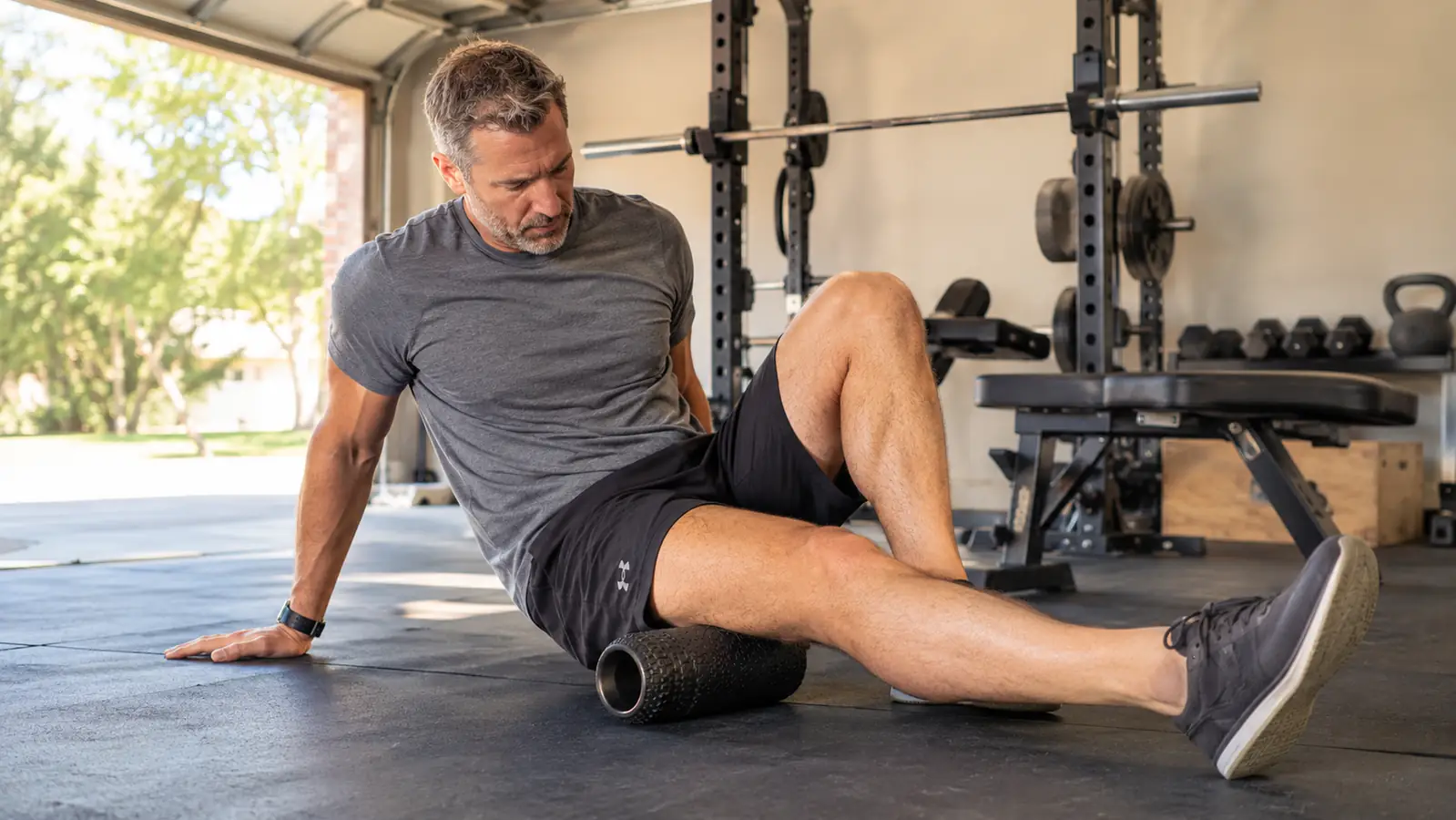
The first thing I do most mornings is sit down on a rubber mat in my garage, put a TRIGGERPOINT GRID under my right hamstring and roll for about five minutes. The second thing I do, on the mornings my knees do not want to fold that far, is wish I had a massage stick leaning against the squat rack where I could reach it without getting down on the floor. Three years of owning the GRID and several seasons of borrowing a teammate's stick in the dugout have taught me one thing: these are not two versions of the same tool. They do different jobs, and the job you actually need is the one that decides which you should buy.
Here is the short answer. The TRIGGERPOINT GRID is a floor tool. Your bodyweight makes the pressure, and 13 inches of roller lays across a wide strip of muscle in one pass, which is why it handles hamstrings, the IT band area and upper back better than anything you can hold in your hands. A massage stick is a standing tool. It slides into a gym bag, it works a calf or a shin while you are on your feet, and it asks nothing of your knees or your hips. If you can get on the floor and stay there for ten minutes, buy the GRID first. If you cannot, or if the tool needs to travel to games, buy a stick. Most people who train past 40 end up with both, and if mine disappeared tomorrow the GRID is the one I would order again before the weekend.
| TRIGGERPOINT GRID (13-Inch) | Massage Stick | |
|---|---|---|
| Best for | Floor work on hamstrings, quad, IT band area and upper back | Spot work on calves and shins while you are standing |
| Portability | 13 x 5.5 inches and about 1.4 pounds, so it lives on a shelf and stays there | Drops into a gym bag or a dugout bag and disappears |
| Pressure control | Bodyweight sets the pressure, and the multi-density exterior spreads it | Your arms set the pressure, and they tire long before your legs do |
| Getting down on the floor | You are on the mat, which is the point and also the drawback | You stay upright, which matters on a bad knee day |
| Surface contact | 13-inch length covers a wide strip of muscle in a single pass | Narrow barrel works one strip of muscle at a time |
| Durability | Rigid hollow core, 500 pound weight limit, one year limited warranty | Barrel and handles take a beating in a shared team bag |
| Learning curve | A few sessions before you stop bracing the wrong way | Nothing to learn, you hold it and roll |
| Easier first purchase | One buy that should last years of daily use | The thing most people try before they try a roller |
Where the TRIGGERPOINT GRID Wins
Pressure is the whole argument. On the GRID, pressure comes from how much bodyweight you sink into it. Lean a little more onto the hamstring and it bites harder, ease off and it softens, and the change happens without you thinking about it. That is also why I can park on one knot for thirty seconds and still be breathing through my nose. With a stick, my arms are the engine. By the time I roll down one quad and back up, my forearms are shot and my shoulders have crept up around my ears, which is a strange way to relax. I timed that once out of curiosity. A full pass down each quad and back with the stick took me about four minutes and I had to stop twice to shake my arms out. The same ground on the roller costs me nothing but patience.
The second win is coverage, and the third is that it holds up. Thirteen inches of roller lays across the muscle so I am not chasing it around, and the 5.5-inch diameter keeps me lifted off the mat far enough to get some leverage behind the stroke. That diameter is doing more work than people realize. Anything much thicker rolls you off the spot you were trying to reach. Anything much thinner digs in like a broom handle. I have only owned this one roller, but I have used a smooth one in the school weight room and it felt like lying on a pool noodle, which is not the same job at all.
The exterior is a multi-density foam built over a rigid hollow core, rated to 500 pounds, and after three years of near-daily mornings mine has not gone soft, cracked, or flattened in the middle. TRIGGERPOINT puts a one year limited warranty on it, which tells you what they expect it to survive. One honest note: it is extra firm. My first two weeks on it felt like rolling on a fence post, and I had to back off before my hamstring quit arguing with me.
Where a Massage Stick Wins
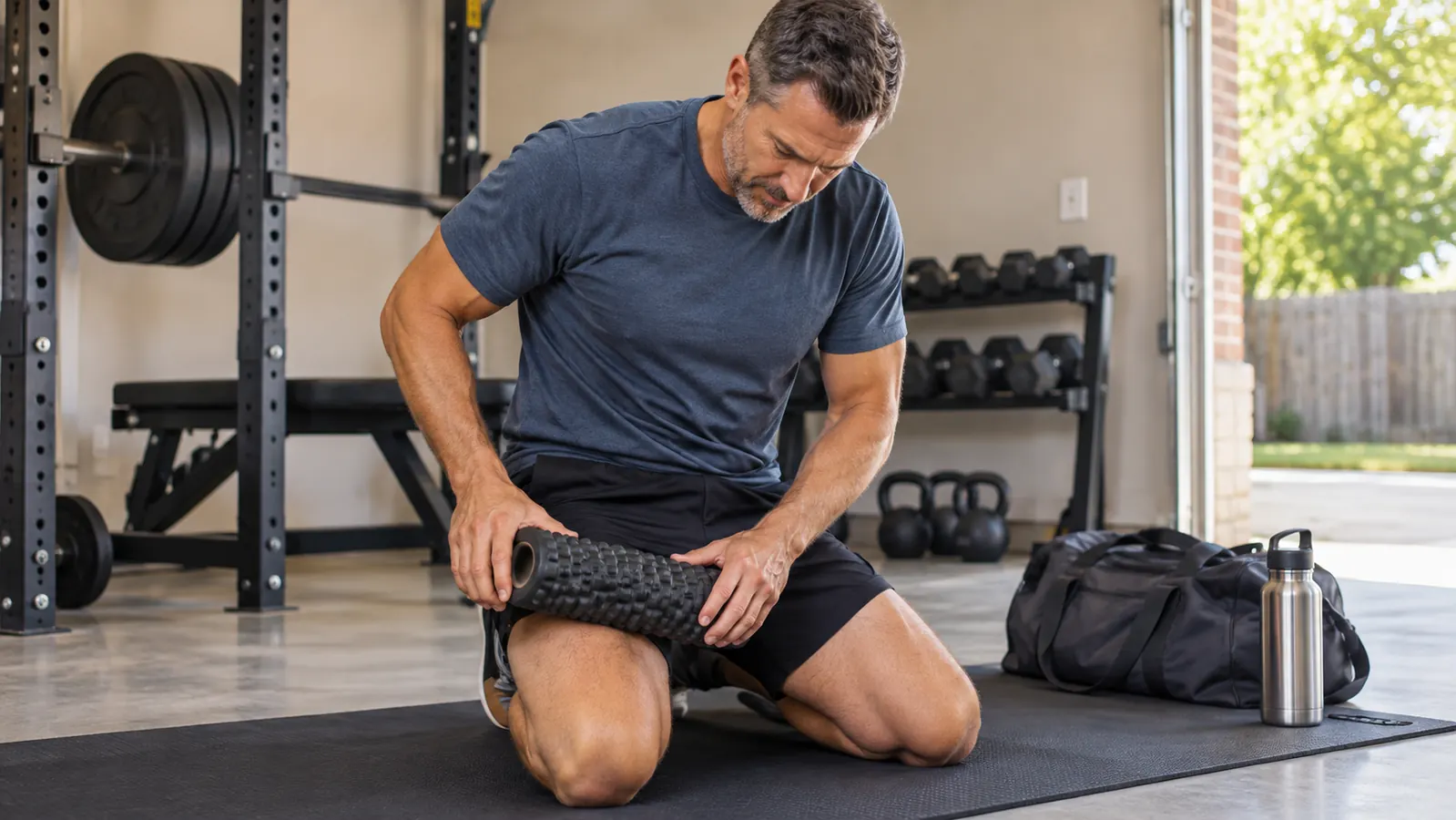
The stick wins the fight I actually lose, which is the fight about getting down on the floor. Tuesday night basketball leaves my quads sore and my knees stiff, and at 6:15 the next morning the last thing I want is to fold myself onto a mat. With a stick I stay standing in the garage, work each quad and each calf for a minute, and get on with the day. My teammate's stick got used the same way in the dugout before a doubleheader while I stood next to the bat rack and talked to him. You cannot do that with a roller. You cannot do it in a parking lot before a 9 a.m. game either, and nobody wants to see a 46-year-old spread out on the asphalt.
It also reaches a couple of spots where the roller makes things awkward. Calves and shins are easier on your feet with two handles than kneeling on a mat trying to balance on one knee. There is nothing to learn: hold the handles, roll the barrel up and down, that is the whole skill. And it is the easier first purchase to justify, which is why almost every player I know owned a stick before he ever owned a roller. If you are brand new to any of this and you are not sure you will stick with it, a stick is the low-commitment way to find out whether rolling even helps you. It is also the easier tool to hand to a teenager who will give it ninety seconds and then go find his glove.
The tool I reach for five mornings a week, sore knees and all
Thirteen inches long, 5.5 inches across, extra firm, with a rigid hollow core rated to 500 pounds and a one year limited warranty. If your tight spots are hamstrings, the IT band area and upper back, this is the one that covers all three without your arms quitting first.
Amazon Check Today's Price on Amazon →How Both Fit in My Week
My week runs on Tuesday nights and weekend games. Tuesday is men's league basketball, which at my age is forty minutes of trying to remember how tall I used to be. Wednesday morning I am on the mat with the GRID, hamstrings first, then the IT band area on each side, then a slow pass on my upper back with the roller under my shoulder blades. That is a nineteen-minute routine if I do not get distracted, and it is the difference between walking normally on Thursday and limping through the school hallway pretending I am fine.
The stick handles the front of the leg on mornings when my knees are not cooperating. Quads and calves, standing up, one minute each, done in four minutes total. I also use it before I lift in the garage two or three mornings a week, mostly on the calves, because a tight calf turns into a tight hamstring for me and then everything above it starts complaining. My right hamstring has always been the loud one, which is exactly why the roller gets the floor work and the stick gets the quick passes. There is one morning from last February I still remember clearly. Bad Tuesday game, 6 a.m. alarm, bus duty at 7:15, quads already sore. No mat, no time. Two minutes per quad with the stick, standing in the garage with my coffee going cold on the workbench, and I walked that hallway without a single flinch.
Spring and fall softball is where the stick earns its keep, because that is a doubleheader on Saturday and another game on Sunday and no mat anywhere in sight. That is not a scenario where a floor tool helps. It is also not the scenario where a stick replaces the roller. It just means the two tools have two different homes: the GRID on the wire shelf by the door to the house, the stick in my gym bag behind the seat of the truck. If you want the deeper version of how I got to that setup, I wrote about it separately in my long-term GRID review, and the reasons a roller is worth owning at all are in the list I put together for athletes who are still competing.
Three years, five mornings a week, same roller, and the exterior has not gone soft or flattened in the middle. That is the whole review.
The Details Nobody Mentions
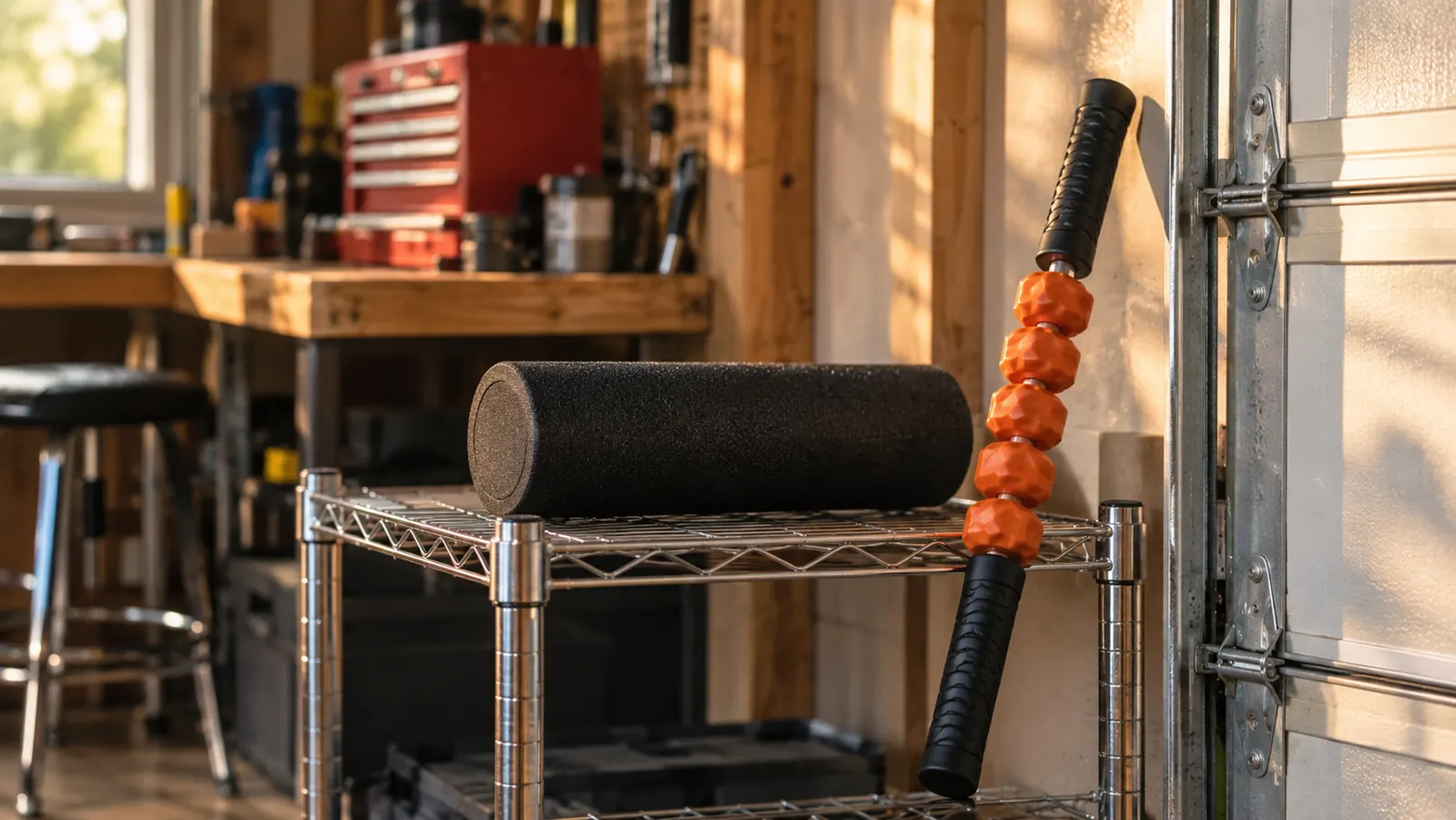
Thirteen inches is the right length for a first roller, and I say that as someone who has only owned the one. Long enough to lay across a hamstring, short enough that I can steer it with two hands when it is under my upper back. The hollow core is the part that matters more than people think. It is what keeps the thing rigid under your bodyweight instead of squashing and rolling you off balance, and it is why mine still sits square on the mat instead of bowing in the middle like a banana.
Two more things I wish somebody had told me. Extra firm means extra firm, so give yourself two weeks to adjust and do not judge it on day one. And the roller comes with access to a free online instructional video library from TRIGGERPOINT, which I ignored for about a year because I assumed I already knew how to roll. I did not. Twenty minutes of watching someone who actually knows the technique saved me from the IT band mistake I had been making, which was basically rolling fast and hard over the sore spot like I was trying to sand it off. The part that stuck with me was how slow they went. Maybe an inch a second, stopping on the tight spot and just breathing there instead of grinding through it. I had been going three times that speed and wondering why the soreness came back by Friday. Slower and more weight beats faster and more force every time.
Who Should Buy Which
Buy the TRIGGERPOINT GRID if you can get down on a mat and get back up without help, if you want to work on hamstrings, quads, the IT band area or your upper back, and if you want one tool that is still going to be on the shelf in three years. Buy it first if you are past 40 and still playing something, because that is the person with soreness spread across the whole leg rather than in one spot. Buy it if you have somewhere to leave it, since a roller you have to dig out of a closet is a roller you will not use.
Buy a massage stick instead if getting to the floor is a chore, if your problem spots are calves and shins, or if you need something in the dugout or on the sideline before a game when there is no room to lie down. Buy it if you are not sure any of this works for you yet and you want to test the idea on a Tuesday before you commit to a routine. It is also the better tool for a player like Tanner, who is 14 and will use it for ninety seconds before a travel game and nothing else, because a stick asks nothing of him.
If you are going to own both, my order is simple. Get the GRID first, since it does the work that actually changes how Thursday feels. Add a stick when you get tired of standing in a garage at 6 a.m. wishing you had one. And one thing I mean seriously: if something is torn, catching, or swollen, none of this fixes it. Rolling is maintenance for a body that is basically fine. If it is a real injury, see a doctor.
If you can give it five minutes on the mat, it will give you a Thursday that does not hurt
This is the one that stays on the shelf by the door and gets used before work, not the one that sounded good in January. Multi-density exterior over a rigid hollow core, extra firm, 13 by 5.5 inches, one year limited warranty. Start with the floor work and add the rest later.
Amazon Check Today's Price on Amazon →