
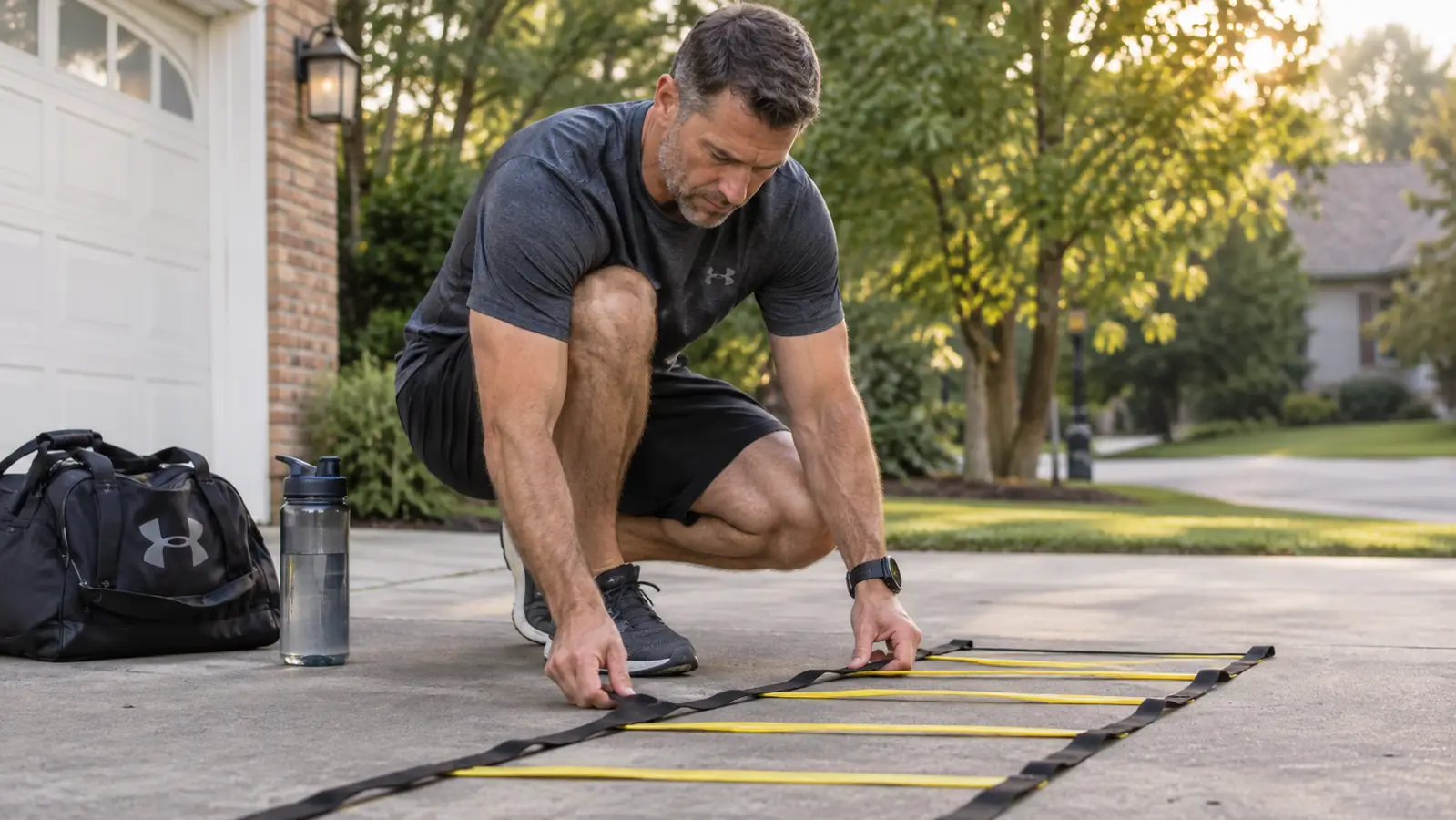
My right hamstring used to tighten up before I even got to the good part of a workout. I am 46, I play men's league basketball on Tuesday nights, and I still catch softball doubleheaders in the spring. Nothing was torn. I was just sloppy. About seven months ago I bought the GHB Pro Agility Ladder, mostly because it was small enough to keep in the truck and simple enough to use on the driveway. I used one ladder twice a week at home. The second one went into the team bag for my son Tanner's travel baseball practices. That is the whole setup.
Footwork is one of those things everybody talks about and almost nobody trains on purpose. You can run hills and lift in the garage and still look like you are wearing ski boots when you try to change direction. The GHB ladder gives you a simple job: put your feet in the right place, one rung at a time, until your body stops arguing. This model has 12 rungs and runs 20 feet. Each rung is 16.5 inches long, and you can adjust the space between rungs up to 15 inches. A tighter ladder trains quick feet. A wider ladder trains longer strides. I use both settings depending on the day.
The ladder that lives in the truck, not in the garage
I keep one GHB ladder on the driveway and one in the bag for Tanner's practices. It sets up in about a minute, and it does not need a screen, a battery, or a power outlet.
Amazon Check Today's Price on Amazon →It teaches your feet to fire in the right order
Fast feet are not the same as good feet. The ladder forces a sequence: land, push, clear the rung, repeat. When I rush, my right foot clips a rung and I hear it. That feedback is the point. After a few weeks, my feet stopped crossing over when I got tired. I am not training for a combine. I am training so I do not trip over my own feet in the second half.
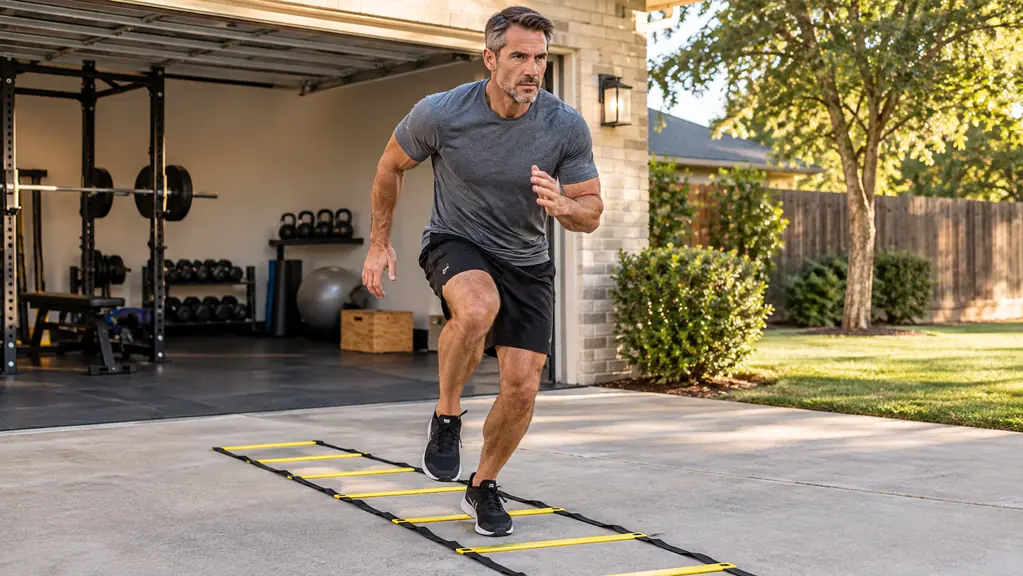
It gives you a speed workout without the pounding
I still lift two or three mornings a week, but my knees do not want another day of sprinting on concrete. The ladder is low impact. You are moving quickly, but you are not covering ground or slamming into a stop. For a 205-pound guy with stiff hips, that is a trade I will take every time. My right hamstring still gets tight, but it does not get tight from the ladder.
It exposes the lazy foot you did not know you had
Most guys are stronger on one side. I am stronger on my left. The ladder found that out in about 30 seconds. My right foot would drag, skip a rung, or land flat. Once you see it, you can fix it. That is worth more than another set of calf raises. I still do the calf raises. I just do them after I have reminded my right foot how to land.
It builds a rhythm you can carry into a game
Change of direction is not just cutting. It is cutting on time. The ladder gives you a cadence, and that cadence shows up when you backpedal on a basketball court or break on a fly ball. I am not going to pretend I got faster overnight. I got less late, and less late is faster. The first step is the one that matters, and the ladder makes you practice it over and over without a defender in your face.
It fits a real warmup in under five minutes
I do not have 45 minutes to warm up before a Tuesday night game. Two lengths down and back takes about four minutes. I do it after a short jog and before I touch a basketball. My hips feel less locked up, and I am not spending the first quarter trying to catch up to my own body. Tanner does the same two lengths before travel practice. It is short enough that he does not complain, which is its own kind of endorsement.
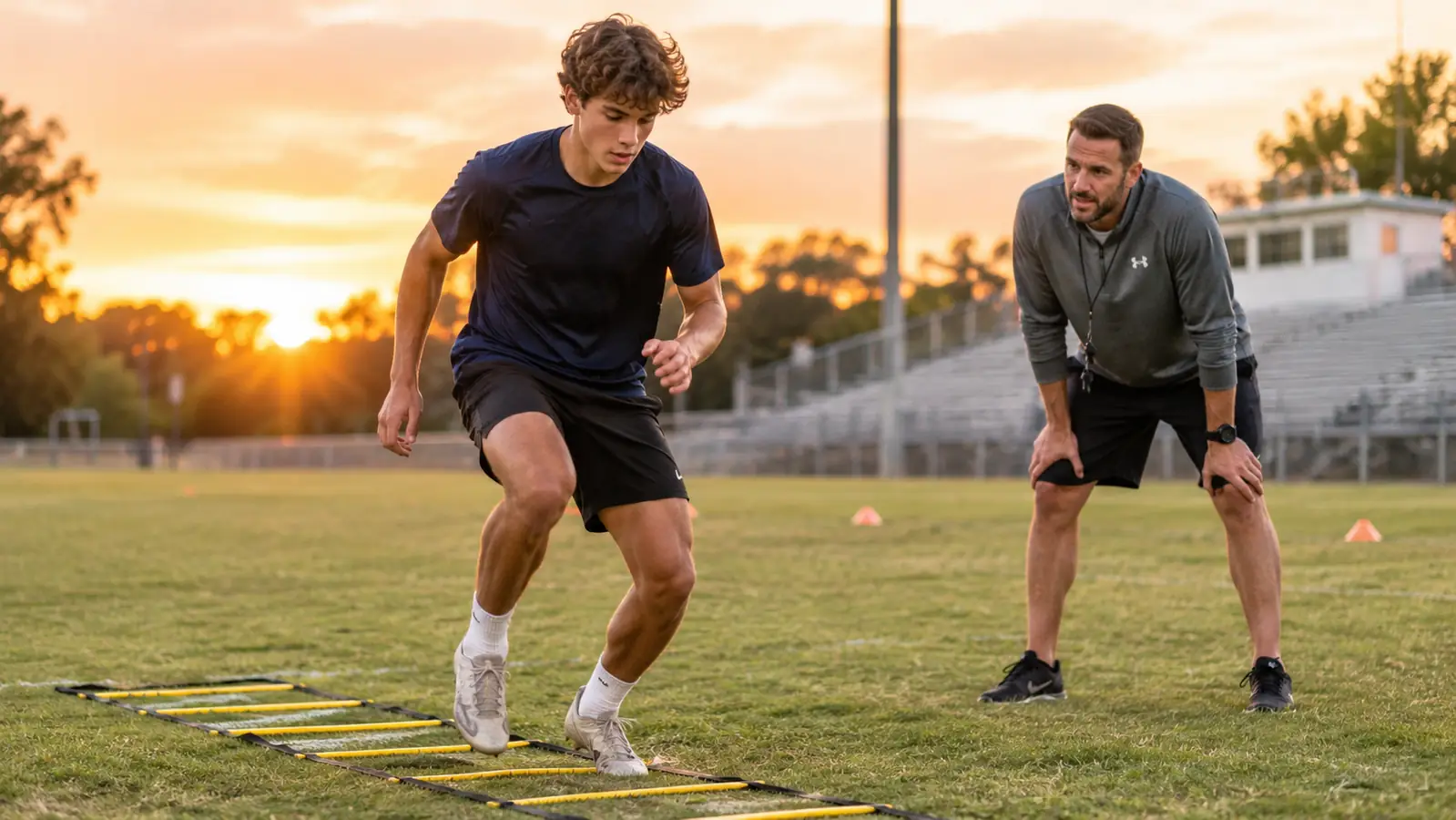
It gives you a simple way to see progress
You do not need a timing system to know if you are improving. Count clean passes. If you clip three rungs on the first length today and one next month, you are getting better. I also time one length with a phone stopwatch sometimes, but the clean-pass count is the honest number for me. It is simple enough that I actually do it, and that is more than I can say for most tracking gadgets.
It trains your eyes and feet at the same time
Looking down at your feet is a bad habit in every sport. The ladder lets you practice keeping your head up while your feet do the work. I put a cone at the end of the driveway and stare at it. The first week I was terrible. The second week I stopped watching my feet so much. That transfer is the reason I keep using it. The ladder is not a shortcut. It is repetition with a target.
It works for a 46-year-old and a 14-year-old
I use the wider rung spacing. Tanner uses it tighter for quick feet. That is the adjustable part doing its job. The ladder does not care who is on it. It is plastic, it is 20 feet long, and it has held up for seven months of driveway use and team practices. The two-year warranty is a nice backup, but I have not needed it. The 2-pack is the reason both of us can use it without one of us waiting.
It packs into a bag and goes where you go
The GHB ladder comes with a carrying bag. That sounds small until you are the guy carrying three bags of baseballs and a bucket. One ladder stays in my truck, one stays in the team bag. Setup takes maybe a minute. If a piece of gear is a pain to move, it stays in the garage. This one does not. It has ridden behind the seat of my truck since spring and it has not been left at home yet.
It makes your cone drills better, not obsolete
The ladder is not a replacement for cone drills. It is a warmup for them. I do two ladder lengths, then run the same change-of-direction drill I would have run anyway. My feet are quieter and my cuts are cleaner. If you already have cones in the team bag, keep using them. Just do not skip the part that teaches your feet where to land. The ladder and the cones do different jobs, and I want both.
What I'd Skip
What I would skip is turning the ladder into a conditioning test. It is a footwork tool, not a wind sprint. I would also skip doing it on a slick concrete floor in old shoes, and I would skip any plan that ignores a real injury. If something hurts in a way that does not go away, see a doctor. No ladder fixes that. What I would not skip is the boring part: two lengths, twice a week, for a couple of months. That is where the change shows up. The ladder is not going to do the work for you. It just tells you the truth about your feet.
The ladder did not make me fast. It made me less sloppy, and less sloppy is faster on a Tuesday night.
Two lengths, twice a week, and your feet stop arguing
I am not a trainer. I am a 46-year-old assistant athletic director who got tired of feeling like his feet were behind the rest of him. The GHB Pro Agility Ladder is the tool that helped me clean that up. Start with one ladder and a team bag. The rest is reps.
Amazon Check Today's Price on Amazon →