
The first thing to go is not the jump shot. It is the second step. Last winter I would come home from Tuesday night men's league basketball and feel it for two or three days. Nothing torn, nothing that sent me to a doctor. Just stiff hips and a right hamstring that had quietly decided it was finished for the night by the second quarter. I am 46 years old and I caught for four years in college, which means my knees have spent more time in a squat than most people's have spent in a chair. I could still shoot. I just could not get anywhere fast enough to be useful.
So I did what every guy my age does. I stretched more. I rolled my hamstrings on the foam roller three mornings a week, which I still do and still like. Both helped a little. Neither touched the real problem, which was that my feet had gotten slow and careful. I was planting instead of stepping. I was waiting for the play instead of getting to it.
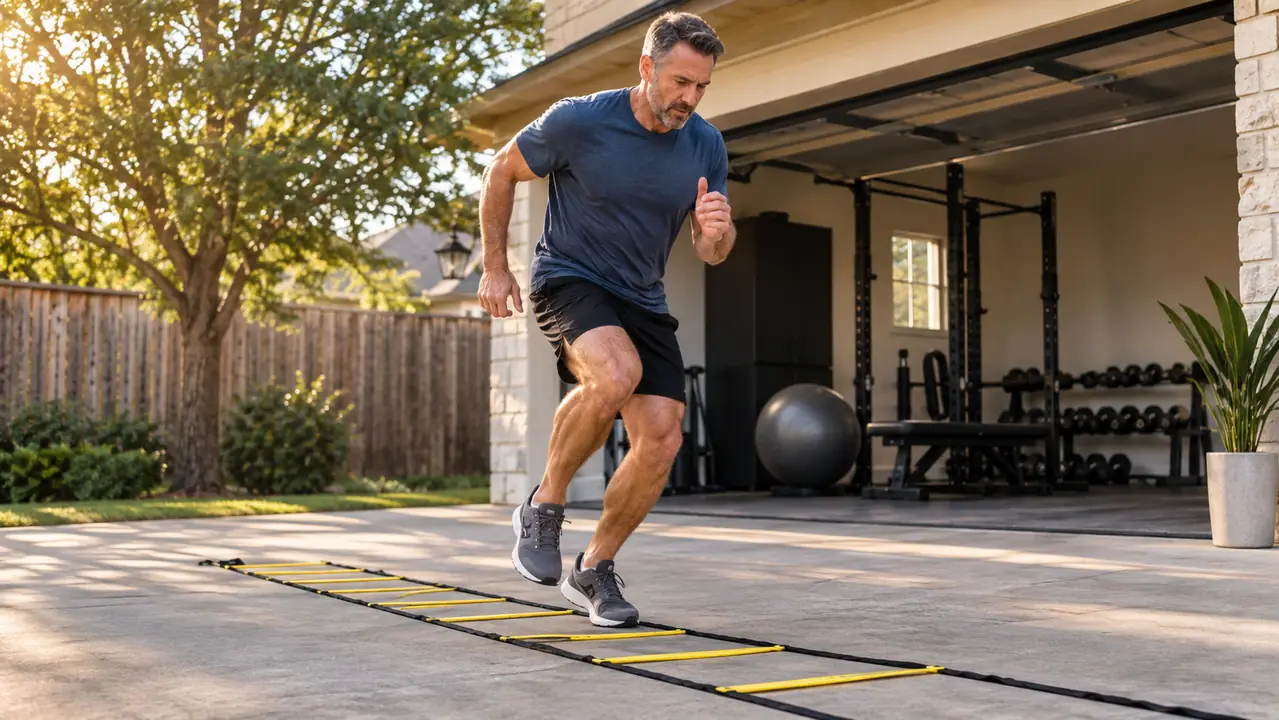
That is what sent me back to a piece of equipment I had not touched since college. I bought the GHB Pro Agility Ladder about seven months ago, the 2-pack, 20 feet long with 12 rungs. One stays on my driveway. The other lives in the team bag so my son Tanner's travel baseball team can use it at practice. It was the first agility ladder I had ever bought for myself, and I paid for it out of my own pocket like everything else in that garage.
Here is the honest reason I picked a ladder over something more expensive. Footwork is a skill, and skills need reps. A ladder gives you a lot of very small reps in a short amount of time, and it does not care how old you are or how much you can squat. You either put your foot in the box or you do not. There is no way to cheat it.
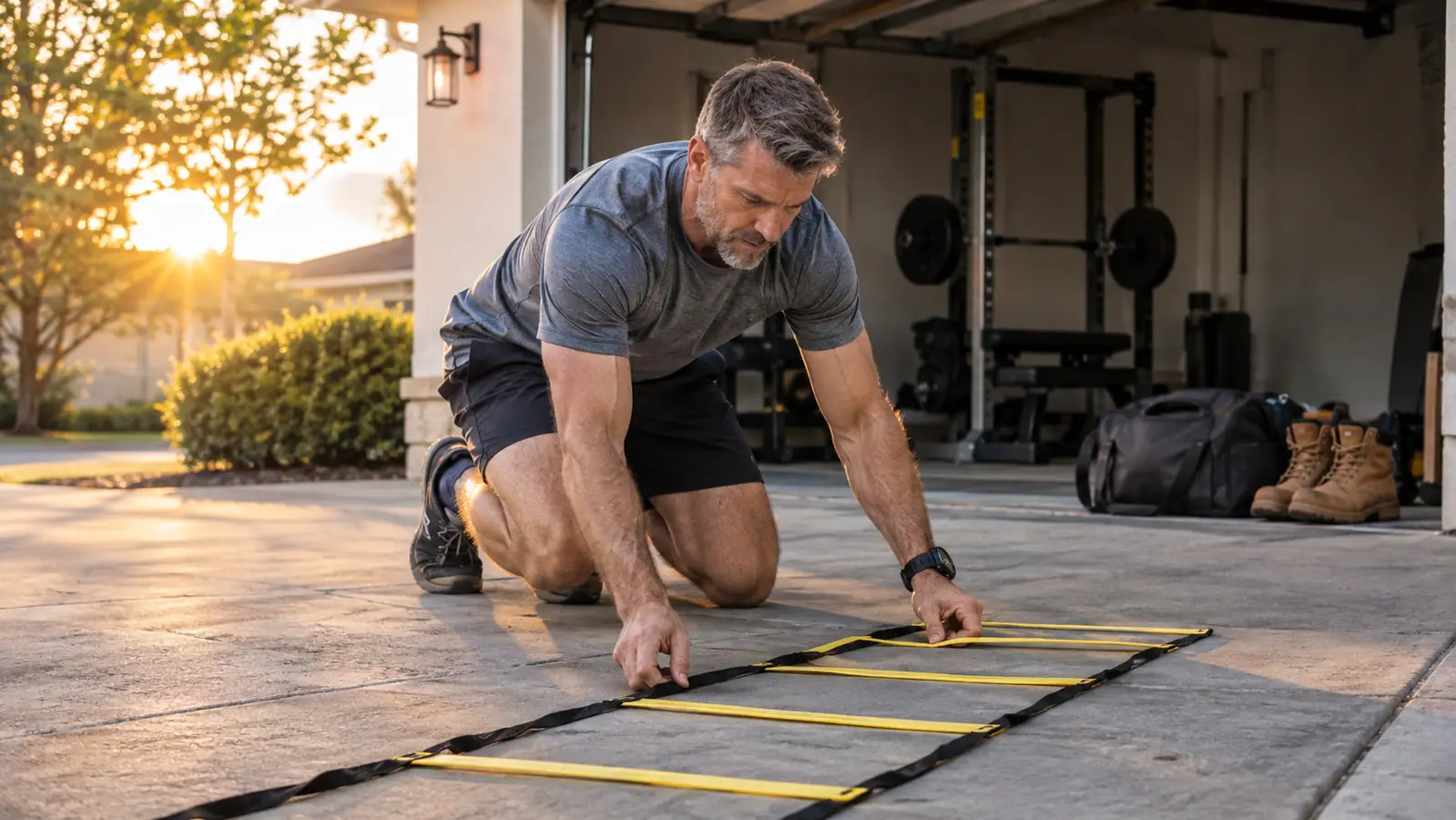
My whole program is ten minutes, twice a week, on the driveway before I lift. That is it. I jog to the end of the block to warm up, lay the ladder out, go through four patterns, put it away, and go lift. I am not going to dress that up into something bigger than it is.
The soreness after Tuesday basketball went from three days to one, and the only thing I added was ten minutes on the driveway.
Ten Minutes, Twice a Week, and a Ladder That Fits in a Trunk
The GHB Pro Agility Ladder comes as a 2-pack: 20 feet, 12 plastic rungs, each rung 16.5 inches long with spacing you set yourself up to 15 inches apart. Two carrying bags come with it, so one stays home and one goes to practice.
Amazon Check Today's Price on Amazon →Setup takes about a minute. Twelve plastic rungs, each one 16.5 inches long, spaced however you want up to 15 inches apart. I run mine at roughly 14 inches, close to the top of the range, because I want my feet to have to travel. When I first got it I had the rungs much tighter and it was too easy, and easy is not the point.
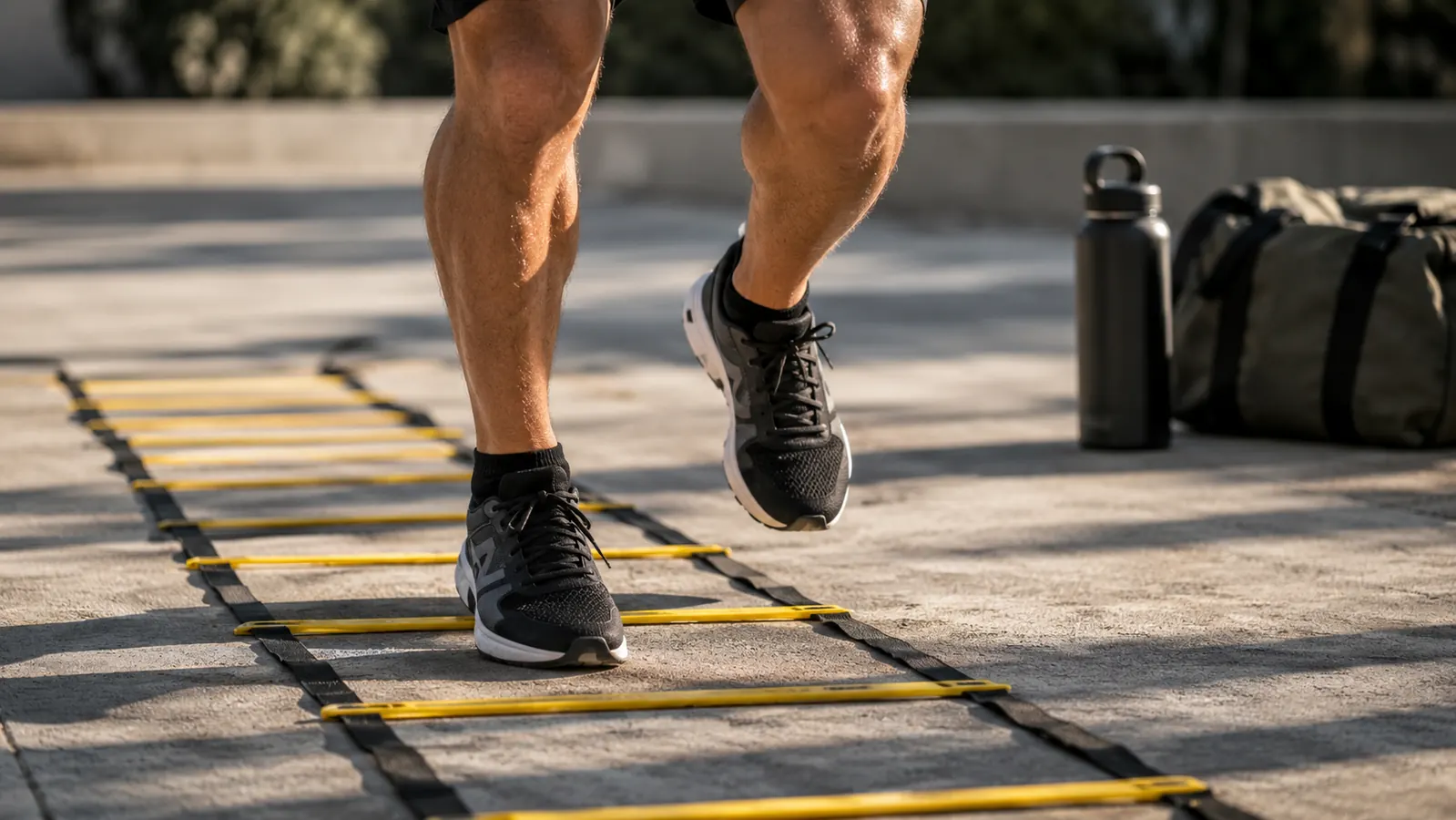
Four patterns, two trips each. One foot in every box, slow and clean, so my hips have to open and close. Two feet in every box, which is where I feel the hamstring most. In-in-out-out, both feet in and then both feet outside. Then lateral, facing the same direction the whole way, which is the one that actually looks like sliding your feet on defense. Two controlled trips through each, then one faster trip if my legs feel good. If they do not feel good, I stop.
The change was not dramatic and I am not going to sell it like it was. Nobody is handing me a roster spot because I can run a ladder. What happened is smaller and more useful. My feet started moving before my brain finished deciding. On defense in men's league I stopped crossing my feet. The soreness after Tuesday basketball went from three days to one, and the only thing I added was the ladder.
It is not perfect. On the smooth part of my driveway the rungs slide when I push off hard, so I moved the whole thing back to the rougher apron near the garage door and that solved it. The carrying bags are thin, and I would not trust one to survive a full season in a dugout, though the GHB ladder itself has held up through seven months of Texas heat and a lot of teenage cleats. The box comes with the ladders and the bags, nothing else, so I used the patterns I remembered from college.
The second ladder earned its keep faster than the first one did. Tanner's travel team uses it for warmups, and the coaches like that it breaks down into the bag and fits in a trunk next to the bucket of balls. Twenty feet is long enough to run a full pattern and short enough to lay out in the grass beside a field. It carries a two-year warranty, which I have not needed yet.
What I'd Tell You If We Were Sitting at My Kitchen Table
If you are in your forties and your feet have gone slow on you, I would spend ten minutes a day on the boring stuff before I spent real money on anything with a motor or a battery. Lay a ladder on the driveway. Put your foot in the box. Do it twice a week for two months before you decide whether it worked, because the first two weeks you will feel clumsy and clumsy is not the same thing as not working. If something hurts sharp, or comes on sudden, or keeps you up at night, that is a doctor conversation and not a ladder conversation. I am not a trainer and I am not going to pretend to be one. I just know what it feels like to be a step slow, and I know this is the simplest thing that got me moving like myself again.
Get Your Feet Back Under You Before the Season Starts
Two ladders, two bags, 20 feet of footwork you can lay out in your own driveway. That is the whole purchase.
Amazon Check Today's Price on Amazon →