
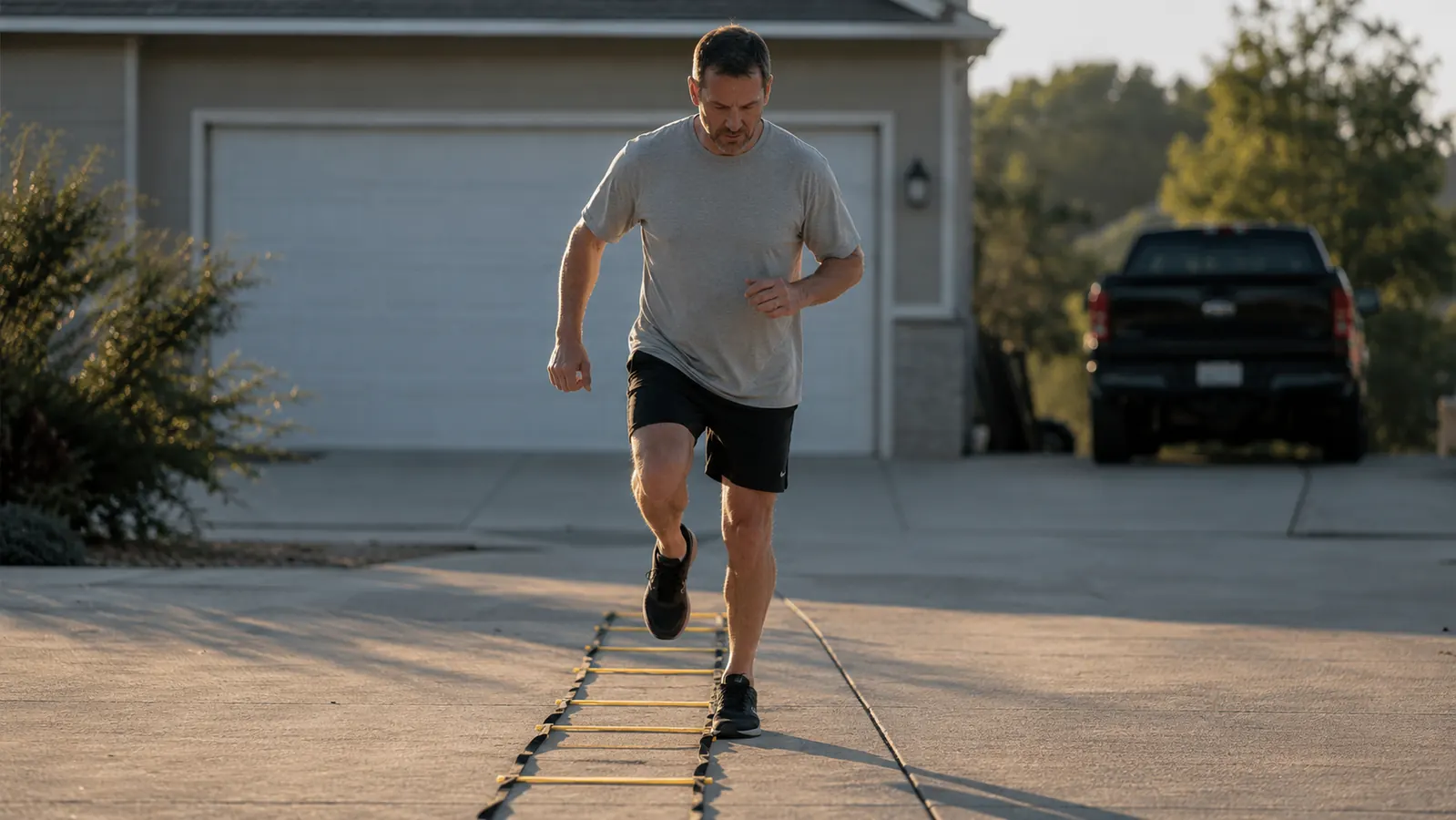
My right hamstring has been tight since roughly the Clinton administration. I caught four years of college baseball, which means my knees and hips keep a long memory, and at 46 the warmup stopped being optional somewhere around my fortieth birthday. Last winter I noticed something worse than stiffness. After Tuesday night men's league basketball I was sore for two or three days instead of one. Nothing torn. No injury story. Just a body that had quit forgiving me for skipping the boring part of training.
So I started doing the boring part. About seven months ago I bought the GHB Pro Agility Ladder, the 2-pack with 12 rungs and 20 feet of run per ladder, and started running footwork on my driveway twice a week before I ever touched a basketball. One ladder lives by the garage door next to my gym bag. The second one rides in the team bag for my son Tanner's travel baseball practices, because he is 14 and believes footwork is something that happens to other people.
The Quick Verdict
Light, simple, and it does one job well. Twelve rungs over 20 feet is enough run for real drills, and the second ladder in the pack is the reason I would buy it again.
Amazon Check Today's Price →One ladder for your driveway, one for the team bag
Twelve rungs, 20 feet of run, spacing that adjusts up to 15 inches in about a minute, and two carrying bags. It folds down small enough to live behind the seat of a truck.
Amazon Check Today's Price on Amazon →How I've Used It
My routine is not complicated and it is not impressive. Twice a week, usually Tuesday morning before I leave for the school and Saturday morning after coffee, I lay one ladder down the driveway, run eight to ten minutes of patterns, and go back inside. That is the whole session. I am not running a periodized speed program. I am waking up the muscles that decided to sleep through my thirties so they are awake by the time I do something stupid on a basketball court.
The patterns I actually use are the boring ones. One foot in each square. Two feet in each square. Lateral in-and-out. And a simple in-in-out-out that I stole from a track coach at our school who has been doing this since before I could walk. Eight to ten minutes at a pace where I can still hold a conversation gets my hips and ankles through a range they otherwise skip entirely. Then I do my normal warmup and go play.
What I tried before this was four minutes of static stretching in the driveway and then walking onto the court cold. That is not a warmup, that is a stretch and a prayer. A guy in my softball league told me his physical therapist had him doing footwork before games and I laughed at him, and then about a month later I tried it. Stretching asks a tight muscle to relax. Footwork asks it to work. My hamstring has responded a lot better to being given a job than to being asked to let go of something.
Session structure, if you want it. Two easy passes of one-foot-per-square to get the blood moving. Four or five passes of whatever pattern I am working that day. Then two slow passes at half speed to settle my feet down before I walk inside. That whole sequence is under ten minutes and I have run it in the dark with nothing but the porch light on more than once, which is a decent argument for owning your own ladder instead of borrowing the school's.
One thing worth knowing before you buy: the rungs are 16.5 inches long. That is fine for a ladder laid straight, but if you angle it or run a pattern that drifts, your feet find the edge faster than they would on a wider ladder. I fixed that by paying attention, which is honestly the point of the whole exercise. A ladder that forgave sloppy feet would be a ladder that taught you nothing.
What the Adjustable Rungs Actually Change
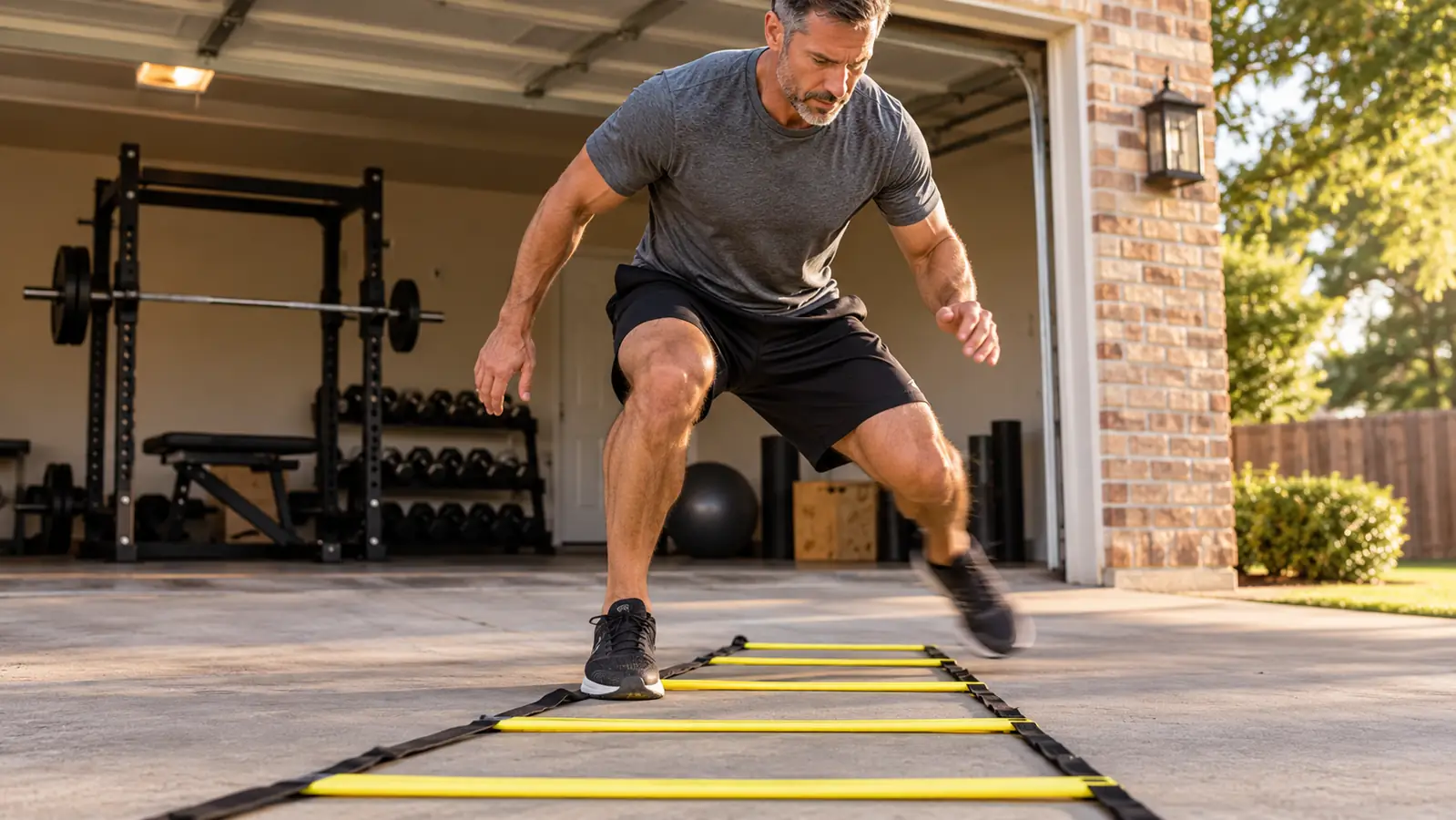
The spacing between rungs adjusts up to 15 inches, and each rung slides along the side rails. That adjustment is not a marketing checkbox. Wide spacing at 15 inches turns the GHB ladder into a stride and reach drill, the kind of thing that exposes how short your natural walking stride has gotten. Snug it down and you get quick, choppy foot contacts that find every lazy step you own.
I keep mine somewhere in the middle, maybe 12 to 14 inches, and change it depending on the day. Tuesday after a hard game, wide. Saturday when my legs feel decent, tight. Being able to change that in about a minute without untying anything or moving the whole setup is the difference between me actually doing the drill and me finding an excuse to go inside and make coffee.
The 15-inch setting is the one that humbled me. I laid it out wide on a Saturday in February and could not get through a full 20 feet without breaking rhythm. The reach forced my stride open and my right hip wanted no part of it. Two weeks of running it wide once a week and it loosened up enough that I stopped noticing. Now the wide setting is my weekly check and the rest of the week stays tighter.
Here is the mistake I made in week one. I eyeballed the rung spacing and ended up with gaps that were close but not equal, and my feet kept catching the same spot three rungs from the end. I could not figure out why until Tanner walked out and told me my ladder was crooked. Now I keep a cheap tape measure on the shelf by the garage door, set the first gap, and count rungs from there instead of measuring twelve times. Twelve rungs at a consistent gap is the whole trick. It is ten seconds of work and it saves you a session of clipping your toe on rung nine.
What Changed After Seven Months
The sore-for-three-days thing is mostly gone. Not vanished, gone mostly. I still feel Tuesday night basketball on Wednesday morning, but I feel it in a normal way instead of a warning way, and by Thursday I am fine. The other change is more interesting to me. My first two or three steps off a basketball catch feel quicker and more deliberate, because I have spent seven months telling my feet exactly where to land instead of hoping they figure it out.
A concrete marker. In late March I played three pickup games on a Saturday morning, which is something I would not have attempted in December. Sunday I was stiff but functional. Monday I ran a light ladder session and lifted in the garage. Tuesday I played men's league. Three years ago that week would have put me on the couch with ice and a bad attitude. I am not handing all of that to a plastic ladder, because I also roll most mornings and use the compression boots a couple of nights a week. But the ladder is the piece that showed up first and the piece I have not skipped.
The change nobody puts in a product description is balance. Standing on one foot to put a sock on should not be an event at 46 and it is not an event anymore. Neither is stepping over a puddle wrong and catching myself instead of stumbling. Those are small things and they are the things I actually care about at this age, more than any number I could put on a stopwatch in my driveway.
I want to be careful here, because I am not a trainer and I am not going to pretend a plastic ladder rebuilt my athleticism. What I did was add a small, repeatable, specific thing twice a week and then not quit doing it. The ladder made it specific. That is the whole claim. Anything more than that would be me selling you something, and I have no reason to.
Durability and the Team Bag Test
The rungs are plastic and the whole thing is light. The box showed up under three pounds and I carried both ladders into the field house in one hand. Light is good for the driveway and good for hauling to a practice field, but light also means this is not equipment you leave in a puddle. After seven months of twice-a-week driveway work plus a full travel season of being dragged around by 13 and 14 year olds, the rungs still hold their position and the side rails are intact.
One specific incident. At a travel tournament in June the team bag got set down in wet grass and the ladder sat damp in the back of my F-150 overnight. I unrolled it the next morning expecting the worst and it was fine. No warping, no rungs sticking, nothing to dry out. I would not make a habit of that, but it survived the one time I did it, and that is more than I can say for a couple of things in that truck.
The rungs slide, that is the design, and sliding means a solid kick will move one. I have re-set a rung mid-session maybe a dozen times in seven months and each time takes about five seconds. If a rung that moves freely sounds like a flaw to you, understand that free movement is exactly what makes the adjustable spacing work in the first place. Pick one or the other.
GHB lists a 2-year warranty and I have not had to test it. The carrying bag looks exactly like a carrying bag that has lived in the bed of a gray 2018 F-150 for a season, which is to say it has some character now. The ladder itself is the part that matters and the ladder itself has been fine. If you are the kind of person who expects a bag to outlast the tool, adjust your expectations and not your opinion of the ladder.
What I Liked
- Twelve rungs over 20 feet is enough run to do real patterns instead of decoration
- Rung spacing adjusts up to 15 inches, so one ladder covers both stride work and quick-feet work
- Light enough to carry in one hand and small enough to live behind a truck seat
- Two ladders in the pack, which means one for the driveway and one for the team bag
- Two-year warranty and nothing on mine has failed in seven months of steady use
Where It Falls Short
- 16.5-inch rungs are narrower than some options, so sloppy foot placement catches the edge
- The plastic rungs move if you kick them, and you will kick them
- No stakes or anchors included, so on grass the side rails shift as you run
- The carrying bag is thin and will show wear before the ladder does
- It does not loosen a tight hamstring by itself. It is a tool, not a treatment
Twice a week, eight to ten minutes at a time, for seven months. The ladder has held up better than my hamstring has.
The Honest Downsides
This is a plastic ladder with a bag. It will not feel like something that came out of a performance lab, because it isn't. Lay it on grass and the side rails will shift a couple of inches as you run, and you will spend more time straightening it than running it. On concrete or turf it stays where you put it. Mine lives on a driveway and in a field house, so I have not had that problem often, but I have had it.
The bigger honesty is this. The ladder did not fix my hamstring. Doing something for it twice a week for seven months fixed my hamstring, and the ladder is just the thing that made that something specific instead of vague. If you buy this and leave it in the bag, you have bought a bag. And if your knee or hip or hamstring hurts in a way that worries you, go see a doctor. I am an assistant athletic director, not a physical therapist, and I have watched enough kids try to train through a real injury to know better than to be the guy who tells you to walk it off.
Ladder Drills Versus the Cones in Tanner's Bag
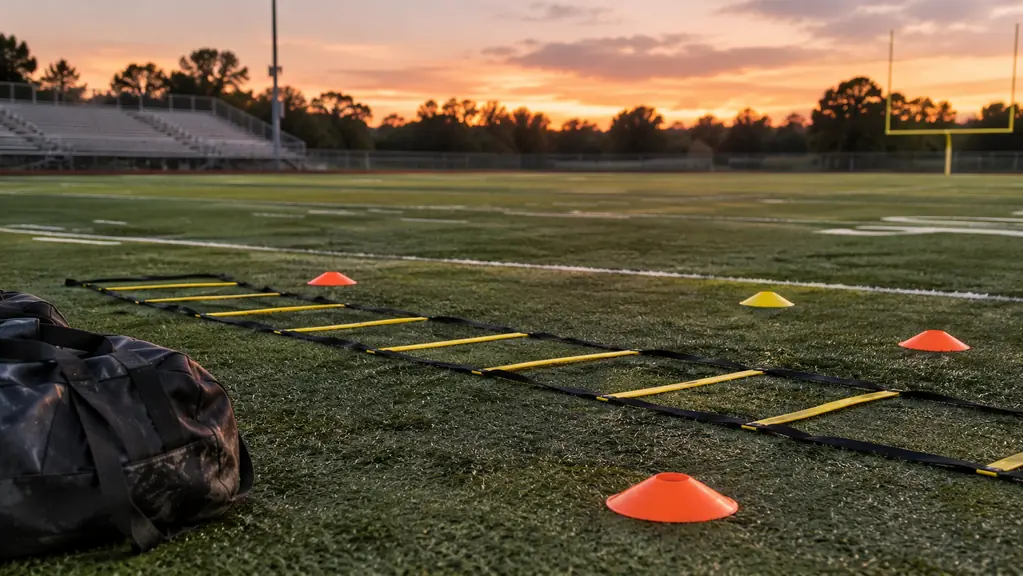
For years my footwork warmup was whatever disc cones happened to be in Tanner's team bag. Cones are fine. They are versatile, they belong to the school so they cost me nothing, and you can set up a cone drill in any parking lot on earth. But a cone gives you a target. A ladder gives you a rhythm. There is a real difference between reaching a spot and putting your foot down cleanly forty times in a row while your brain keeps up.
I still use the cones for change of direction work and for anything with a ball involved. The ladder is what I use when the goal is simply getting my feet moving at a rate that forces me to concentrate. Both belong in a warmup and neither replaces the other. If you can only own one and your problem is that your feet feel slow and your hips feel locked up, the ladder is the one that will show you the problem honestly.
Who This Is For
This is for the guy in his thirties or forties who still plays something twice a week and has accepted that the warmup is not optional anymore. It is for the parent who wants a light, simple piece of gear that a teenager will actually use at practice because it looks like something athletes use. And it is for a coach or an assistant who wants a second ladder in the team bag without asking the booster club for money. It is not complicated and it does not need to be.
Who Should Skip It
Skip it if what you want is a training program, because GHB is selling you a ladder and a bag and nothing else. Skip it if you plan to lay it on grass and expect it to stay exactly where you put it. Skip it if the only reason you are looking is that something hurts, because a ladder is not a rehab plan and the rungs do not know a thing about your knee. And skip it if you already own a ladder you actually use, because a second one in a bag is exactly as useful as the first one was when it was in the bag.
Twice a week, eight minutes, one ladder by the garage door
That is the entire routine that has kept me on a basketball court at 46. Twelve rungs, 20 feet of run, adjustable spacing, and two ladders with two bags in the pack.
Amazon Check Today's Price on Amazon →