

Last February I stood on my driveway with a stopwatch and watched a fourteen-year-old clip the same rung four reps in a row. He was not being lazy. He genuinely could not feel where his foot was landing. I had been running that station for years, first as a player and now as an assistant athletic director who helps coach his son's travel team, and I had never once stopped to ask whether the ladder or the cones were doing the teaching. So I spent seven months finding out.
Short version: they teach different things, and the athletes I work with needed both. The GHB Pro Agility Ladder, the 12-rung 20-foot two-pack I bought about seven months ago, is the better tool for cleaning up a step. Every rung is 16.5 inches long, the space between rungs adjusts up to 15 inches, and the target never moves. Cone drills are the better tool for change of direction, reaction, and running a whole station at once. If a kid's footwork is sloppy in a straight line, the ladder fixes it. If practice has to keep moving, cones still run the show.
| GHB Pro Agility Ladder | Cone drills | |
|---|---|---|
| Repeatable step target | Every rung is 16.5 inches long and spaced to a setting you pick, so every rep hits the same mark | Cones mark a path, not a step, and they drift once they get clipped |
| Reset between reps | Stays where you laid it, straighten it once and go | Needs re-spacing every few reps once athletes start catching the edges |
| Change of direction | A straight 20-foot line, you can angle it but it wants to stay straight | Any shape you draw: L drills, T drills, curves, turns |
| Spacing range | Adjustable up to 15 inches between rungs | No limit, place them anywhere on the field |
| Group size | One athlete at a time per ladder, so the two-pack runs two | Four stations and sixteen kids at once |
| Travel and storage | Rolls into the included carry bags, both fit behind a truck seat | A stack of discs bags up fine but goes missing one at a time |
| Durability | Plastic rungs, 2-year warranty, seven months of driveway use with nothing broken | Cracked and lost cones are a constant, though replacing them is easy |
| Cost to a program | One purchase covers two full ladders and two bags | The ones in our team bag have been there three seasons and cost nothing new |
How I Ended Up Comparing These Two
I am Grady Holcomb, 46, assistant athletic director at a public high school outside Fort Worth. I caught four years of college baseball and my knees have been filing complaints ever since. I help coach my son Tanner's 14U travel team, I play men's league basketball on Tuesday nights, and I lift in my garage two or three mornings a week. I am not a trainer and I am not a physical therapist. What I am is a guy who has watched a few thousand reps and can usually tell when a drill is teaching something versus when it is just making kids tired.
The GHB ladder came home about seven months ago and it was the first ladder I had ever owned. One stays on the driveway and I use it twice a week before I lift. The second one lives in the team bag and goes to Tanner's travel practices. Before that I had borrowed ladders at clinics and used them enough to know I liked them, which is a different thing from owning one and finding out where it annoys you.
The cones are not mine. They are the plastic disc cones that have lived in Tanner's team bag for three seasons, plus whatever I borrow from the equipment room. I have set them up and kicked them across the grass more times than I can count. So this is not two products I bought on the same day. It is seven months with the ladder against roughly thirty years with cones, and that feels like the honest way to lay it out.
One afternoon in March I timed it both ways to settle the argument for myself. Twenty reps through the ladder, then twenty reps over the same distance marked with cones. The ladder reps averaged about a second faster, and more usefully, the last five looked like the first five. The cone reps got sloppier as they went, mostly because the markers had shifted an inch or two by the end. That was the day I stopped treating the two stations as interchangeable.
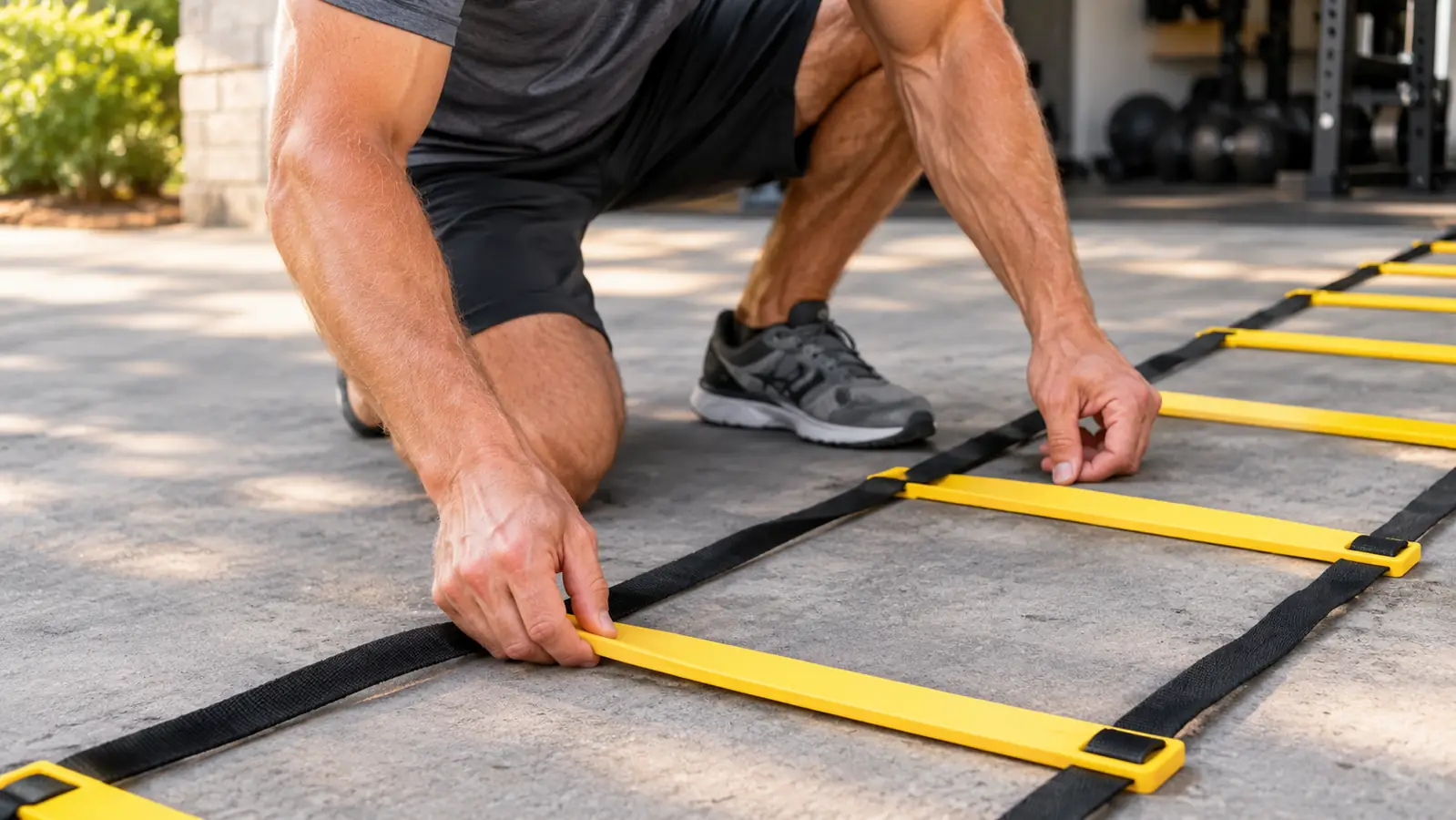
Where the GHB Ladder Wins
The ladder's whole argument is that it removes a decision. Each rung is 16.5 inches long, the space between rungs adjusts up to 15 inches, and once you set it, every athlete on the driveway runs the same target rep after rep. That sounds like a small thing. It is not. A kid who is guessing at his step length is thinking about his feet. A kid running a fixed pattern is thinking about his posture, his arms, and where his eyes are. You cannot coach the second thing until the first thing is settled.
It also stays put. A ladder does not roll when a fourteen-year-old catches it with his heel. It does not drift six inches left over a set of ten reps. When I run a ladder station I can actually compare athletes to each other, because the target did not move between them. With cones, by the fourth rep I am walking out to re-space with my shoe and the comparison is gone.
The two-pack matters more than I expected. One ladder for the driveway and one for the team bag means I am never loading and unloading the thing. Both roll into the carry bags that come with it, and both bags fit behind the seat of my truck with room to spare. Seven months in, the plastic has held up fine, and there is a 2-year warranty behind it, which for gear that gets thrown in and out of a truck bed is more than I expected.
The spacing adjustment paid for itself in a way I did not see coming. The younger kids I work with at our summer camp needed the rungs set close, maybe eight inches apart, just to keep their feet under them and stop the galloping. Tanner's 14U group runs the same ladder at about fourteen inches. Same tool, same drill name, two completely different workouts. With cones, the spacing was whatever a kid guessed when he set them down, which is how you end up with one athlete running a sprint and the next one strolling through the identical station.
Where Cone Drills Win
Here is what the ladder cannot do: it cannot turn. It is a straight 20 feet, and no matter how you angle it in the driveway it wants to be a line. Change of direction lives in shapes. An L drill. A T drill. A curve around a bag. A cone moves anywhere and the shape changes with it, which is why every coach I know still carries them and why the ladder never replaced a single one.
Cones also scale in a way the ladder does not. At a team practice I can set four cone stations and have sixteen kids working at the same time. With my two ladders, two kids go and fourteen watch. If your real problem is that practice is 90 minutes and you have twenty athletes, cones solve a problem the ladder does not touch.
And cones make a kid think. A ladder is a pattern he repeats. A cone drill where a coach points a direction at the last second forces a read and a reaction, and that is closer to what happens in a game than any footwork pattern I can draw on a driveway. The ladder builds the step. The cone is where the step has to survive contact with something unexpected.
Here is the specific afternoon that sold me on that. Last spring we had nineteen kids at a Tuesday practice and two coaches. I set four cone stations in a square, ran four groups on a rotation, and every kid got roughly thirty reps of something in twenty minutes. I cannot do that with two ladders unless I want fourteen of them standing in a line watching two work. The ladder is the better teaching tool per rep and the worse tool per minute of practice, and it took me most of a season to say that out loud.
The ladder never let me lie to myself about a kid's footwork. If he clipped a rung, I saw it on that rep. That is the entire selling point.
If the problem you can see is a sloppy step, this is the place to start
The GHB two-pack I use: 12 rungs, 20 feet, spacing adjustable up to 15 inches, a carry bag for each ladder, and a 2-year warranty. One for the driveway, one for the team bag, so you are never the guy unloading the truck at 5:45 in the morning.
Amazon Check today's price on Amazon →
The Drill Mix I Actually Use
The way I program it is not ladder versus cones. It is ladder first, cones second, in the same session. Ladder work goes early, when the kids are fresh and can feel their feet. Ten minutes, two or three patterns, one of them backward. I start most kids with the rungs spaced wider and tighten it as the steps get cleaner, which is the entire reason the spacing being adjustable matters to me.
Then cones for the part that requires thinking. An L drill with a coach pointing a direction at the last second. A mirror drill. Anything where the athlete reads something and reacts instead of repeating a pattern he already knows. Fifteen minutes of that and the kids are breathing hard and their feet are doing what the ladder taught them five minutes earlier.
One sequence I stole from a clinic and still use: run a ladder pattern, then immediately have the kid sprint ten yards to a cone and cut around it. The ladder sets the step and the cone makes him use it under pressure without a break in between. Tanner hates it, which usually means it is working. We do four rounds of that on a Saturday morning and he is done in under eight minutes, and then he goes inside to eat something while I stand there catching my breath.
If you only have fifteen minutes before practice, and most days you will only have fifteen minutes, use the ladder. The cones are already in the bag and they will keep being in the bag. The ladder is the thing that gets skipped because it takes thirty seconds to unroll and nobody volunteers. Unroll it anyway. Thirty seconds is the whole excuse.
The Setup Details That Actually Matter
A few things I got wrong at first. I started with the rungs at the widest setting because it looked more athletic, and half the team just strode through it without ever picking their feet up. Tightening the spacing is what made the drill hard. You feel it in your calves about four reps in, and that is how you know the athlete is actually working instead of jogging in a straight line.
The second thing is that a 20-foot ladder is longer than my driveway is wide, so I run it lengthwise toward the street. That is fine at 6 a.m. on a Saturday and less fine when a neighbor is backing out. If you have a garage floor or a flat patch of grass, use that instead and save yourself the conversation.
The third thing is that it is a plastic tool and it will tell you when you misuse it. Catch a rung at the wrong angle with a cleat and you will hear it. Seven months in, none of mine have failed, but I also do not let the kids drag it across the concrete by one end. Treat it like gear and it lasts. Treat it like a rope and you will be buying another one.
What I Liked
- Fixed 16.5 inch rungs give every athlete on the driveway the same target, rep after rep
- Spacing adjusts up to 15 inches, so one ladder works for a 12-year-old and a varsity kid
- Two ladders and two carry bags in one purchase, one for home and one for the team bag
- Rolls up and lives behind the truck seat without eating any space
- 2-year warranty, and the plastic has held up to seven months of driveway use
Where It Falls Short
- Straight line only, so change of direction still needs cones
- One athlete at a time per ladder, which makes a big station a bottleneck
- Rungs are plastic and a cleat caught at the wrong angle will let you know
- You have to set the spacing yourself, and skipping it teaches the wrong step
Who Should Buy Which
Buy the GHB ladder if the problem you can actually see is footwork: short steps, heavy feet, kids who cannot feel where they are landing. Buy it if you coach a small group and want a station that mostly runs itself while one coach watches. Buy it if you have a young athlete doing speed work two or three days a week and you want something that fits behind a truck seat. The two-pack is the version that makes sense for a coach, because one ladder at a station is a bottleneck with a line behind it.
Stay with cones if your practices are big and time is short, if you mostly work on change of direction and reaction, or if you already have a full cone set and no complaints about it. And if you are a parent standing in a driveway with one kid, a stopwatch and a bad attitude about mornings, get the ladder and keep using the cones you already own. That is the setup I would hand to any family in our program, and it is the setup sitting in my truck right now.
One ladder on the driveway, one in the team bag, and the step gets fixed
12 rungs, 20 feet, spacing adjustable up to 15 inches, two carry bags, 2-year warranty. That is the whole pitch. Roll it out, check the step, roll it up, put it away.
Amazon See the current price on Amazon →