

Seven months ago I bought the GHB Pro Agility Ladder expecting it to fix my feet. It did not fix my feet. What it did was give me a repeatable ten minutes of footwork on my own driveway, twice a week, that I have actually stuck with. That is a lower bar than the listing photos imply and a higher one than most of the training gear on my garage shelf ever cleared.
So let me be straight with you about what this thing is. The GHB ladder is not a speed program. It is not going to take a tenth off a 40-yard time by itself, and any page that hints otherwise is selling you a story. It is a plastic ladder with 12 rungs, and what it does is force your feet to land in a specific place instead of wherever they feel like landing. That is the entire mechanism. It works, and it works in a small, unglamorous way that you have to show up for.
The Quick Verdict
A sturdy, adjustable two-pack that earns its spot on the driveway. Buy it for footwork and warm-ups, not for speed, and check the rung spacing before every session.
Amazon Check Today's Price →The one piece of training gear I actually use twice a week
Two 20-foot ladders with 12 rungs each, spacing you can widen for young athletes or tighten for game speed, and a bag for each one. One lives on my driveway and the other never leaves the team bag.
Amazon Check Today's Price on Amazon →What Comes in the Box
The package is a two-pack, and that detail matters more than it sounds. Two separate ladders, each 20 feet long with 12 plastic rungs, plus a carrying bag for each one. The rungs measure 16.5 inches across. That number is worth paying attention to, because a narrow ladder quietly turns a footwork drill into a balance drill. Sixteen and a half inches is wide enough that my feet land clean without me aiming them.
The spacing between rungs slides along the side straps and adjusts up to 15 inches apart. This is the feature I use most and the reason I would buy this one again over a fixed ladder. When Tanner's travel team does warm-ups I widen the spacing so the younger kids can get through without clipping a rung on every step. When I do my own work on the driveway I bring them in tight, because a tight ladder punishes lazy feet and that is the whole point.
The package ships at about 1.3 kg, and the box measures roughly 17 by 5 by 3 inches. That tells you what you need to know: it packs down to about the size of a shoebox and it weighs almost nothing. Mine sits on the wire shelf by the garage door without taking the shelf over, and a kid can carry it without complaining, which is the actual reason the second ladder ends up in the team bag instead of getting left at home.
There is a two-year warranty on it. I have not had to test that and after seven months of driveway use I do not expect to. But it is worth saying out loud, because a two-year warranty on a piece of plastic training equipment is more coverage than most of what sits in this category.

How I've Used It for Seven Months
Setup takes about a minute. I lay one ladder out on the concrete driveway, straighten the straps, and set the spacing by hand. Twice a week, usually Tuesday and Saturday mornings, I run through it for eight to ten minutes before I go into the garage and lift. That is it. No program, no app, no timer on the wall.
The patterns are not fancy. Two feet in every square. One foot in every square. Lateral steps through. In and out with both feet. I go through each one twice, walk back to the start, reset the ladder, go again. On Tuesday nights I play men's league basketball and my feet are the first thing that goes, so this work is really about keeping my feet from getting sloppy as a game wears on. It has helped with that. I cannot put a number on it and I am not going to pretend I can.
The second ladder rides in the team bag. Tanner is fourteen and plays travel baseball, and I help coach. We run the ladder in warm-ups before practice, mostly for the infielders. A kid who chops his steps on a ladder chops his steps going after a ground ball, and I have watched that carry over. Not perfectly. Not with every kid. But the ones who take the warm-up seriously look different by the end of a season, and that is the kind of thing a coach notices without needing a spreadsheet.
Here is the part I did not expect. The ladder turned into a measuring tool. When I started, I could not get through a tight-spaced run without clipping a rung somewhere in the middle. Seven months later I can. That is not a dramatic story and I am not dressing it up as one. What I can tell you is that my feet catch themselves more often when I am off balance, and for a 46-year-old with stiff knees, that is worth ten minutes twice a week.
What Nobody Tells You Before You Buy One
Three things. All three would have saved me some irritation if someone had said them up front, and none of them show up in a listing photo.
First, the rungs move. They adjust along the straps, which is the point, and they also drift while you use them. Set the spacing tight, run a hard pattern, and the rungs creep. I check the spacing with my hand before every session now. It takes fifteen seconds. If you skip it, you will finish a workout with a ladder that looks nothing like the one you set up, and you will wonder why the drill felt different.
Second, the ladder is not glued to the ground. On concrete it stays put reasonably well because the plastic rungs carry some weight, but a hard plant or a misstep drags the whole thing a few inches. On a smooth garage floor it slides more. That is true of every ladder built like this one, so I am not calling it a defect, but nobody mentions it and it makes your first week feel sloppier than it should.
Third, and this is the one that matters, the ladder will not fix a stiff hip. For about a year before I bought this, my hips felt locked up in softball warmups, and I assumed a footwork tool would sort it out. It did not. What sorted it out was thirty seconds of band work before every game and rolling on the mat most mornings. The GHB ladder is a skill tool. It is not a mobility tool. If you buy it hoping it loosens something up, you will be disappointed and you will blame the ladder for a job it was never doing.
One more small thing. The carrying bag is basic. It holds the ladder, the strap has not torn, and mine still looks close to new, but that is because it lives inside the team bag and never gets dragged across a parking lot. If your routine involves hauling it loose from a truck bed every week, do not expect much from the bag.
The ladder does not make you fast. It gives your feet a target, and it stops letting you lie to yourself about how clean your steps really are.
What Held Up and What Did Not
Held up: the rungs. Twelve of them, seven months, twice a week, and not one is cracked or bent. The straps have not frayed at the adjustment points, which is exactly where cheap ladders fail first, because that is where the webbing gets worked every time you change the spacing. The plastic has scuffed from being dropped on concrete and that is cosmetic.
Held up: the adjustability. The spacing still slides, still grips, and I have not had a single rung freeze in place. That surprises me. Adjusting plastic on webbing is the kind of thing that seizes up after a summer in a hot Texas garage, and this one has not.
Did not hold up, or rather did not exist: there is nothing in the box besides the two ladders and the two bags. No printed drill sheet, no wall chart, no code for a program. If you already know ladder patterns you will not care. If you are buying this for a kid who is going to train on his own, plan to teach him the patterns first, or he will stand in the driveway looking at it.
The other honest limitation is space. Twenty feet is twenty feet. You can shorten the working area by only using part of the ladder, but the thing wants a straight line, and in my house the only straight line is the driveway. If you were picturing this in a carpeted spare room, measure the room first.
What I Liked
- Rung spacing adjusts up to 15 inches, so one ladder works for a 14-year-old and a 46-year-old
- 12 rungs across 20 feet gives you room for real patterns, not just three steps and a turn
- Two ladders and two carry bags in one package, which is why one lives in the team bag
- Plastic rungs and webbing both survived seven months of twice-a-week use with no cracks or fraying
- Packs down to roughly 17 by 3 inches, so it fits on a garage shelf
- Two-year warranty
Where It Falls Short
- Rungs drift out of position during hard use, so you have to reset the spacing before each session
- Light enough to slide on smooth floors and to move on a breezy morning outdoors
- Carry bag is basic and will not survive being dragged around loose
- No drills or instructions included, so you need to know patterns already
- Needs a straight 20 feet of flat space to be useful
Where the Ladder Fits Next to Cone Drills
I use Tanner's plastic disc cones constantly and I am not giving them up. Cones are better for change-of-direction work, for setting a curve, for anything where the athlete is reacting to open space instead of a slot. The ladder does the opposite job. It is a fixed target that forces clean placement and gets boring in a useful way. Boring is underrated in footwork.
If you want the longer version of that argument, I broke it down separately in GHB agility ladder versus cone drills. The short of it is that most of us need both jobs covered and only have room in one bag, and the ladder wins on portability because it packs down to shoebox size and the cones do not. If you want the wear-and-tear detail in one place instead of scattered through this piece, I put that in the long-term review of the same ladder.
Who This Is For
This is for the coach or the parent who wants a portable, adjustable footwork tool that lives in a team bag and survives a season of being set up and taken down by teenagers. It is for the adult athlete playing a sport two or three nights a week who wants ten minutes of footwork before lifting and does not want to think about programming. It is for the person who will actually set it up, which is a smaller group than the number of people who buy one.
It also suits anyone who has to run a warm-up for a mixed group. The adjustable spacing is the reason. You can set it wide for the younger kids and tight for the older ones without buying a second piece of equipment, and you can do it in the time it takes to walk from one end to the other.
Who Should Skip It
Skip it if you are buying it to get faster without doing anything else. The ladder is a small slice of a bigger picture that includes lifting, actual sprinting, and enough sleep to recover from both. Bought as a shortcut, it will sit in the garage next to the other shortcuts.
Skip it if something in your hip or knee has been barking for weeks. This is not rehab and I am not a physical therapist. I am a 46-year-old assistant athletic director with stiff knees from four years of catching, and I know the difference between tight and hurt. If it is a real injury, see a doctor, get it looked at, and come back to the ladder when you are cleared. No piece of plastic is worth working through pain for.
Skip it if you have nowhere to lay out 20 feet. A hallway will technically hold it if the hallway is long enough, but the drill wants space at both ends so you are not turning around on top of the last rung. The driveway is the answer for most people and a small apartment is not.
Why It Stayed by the Garage Door
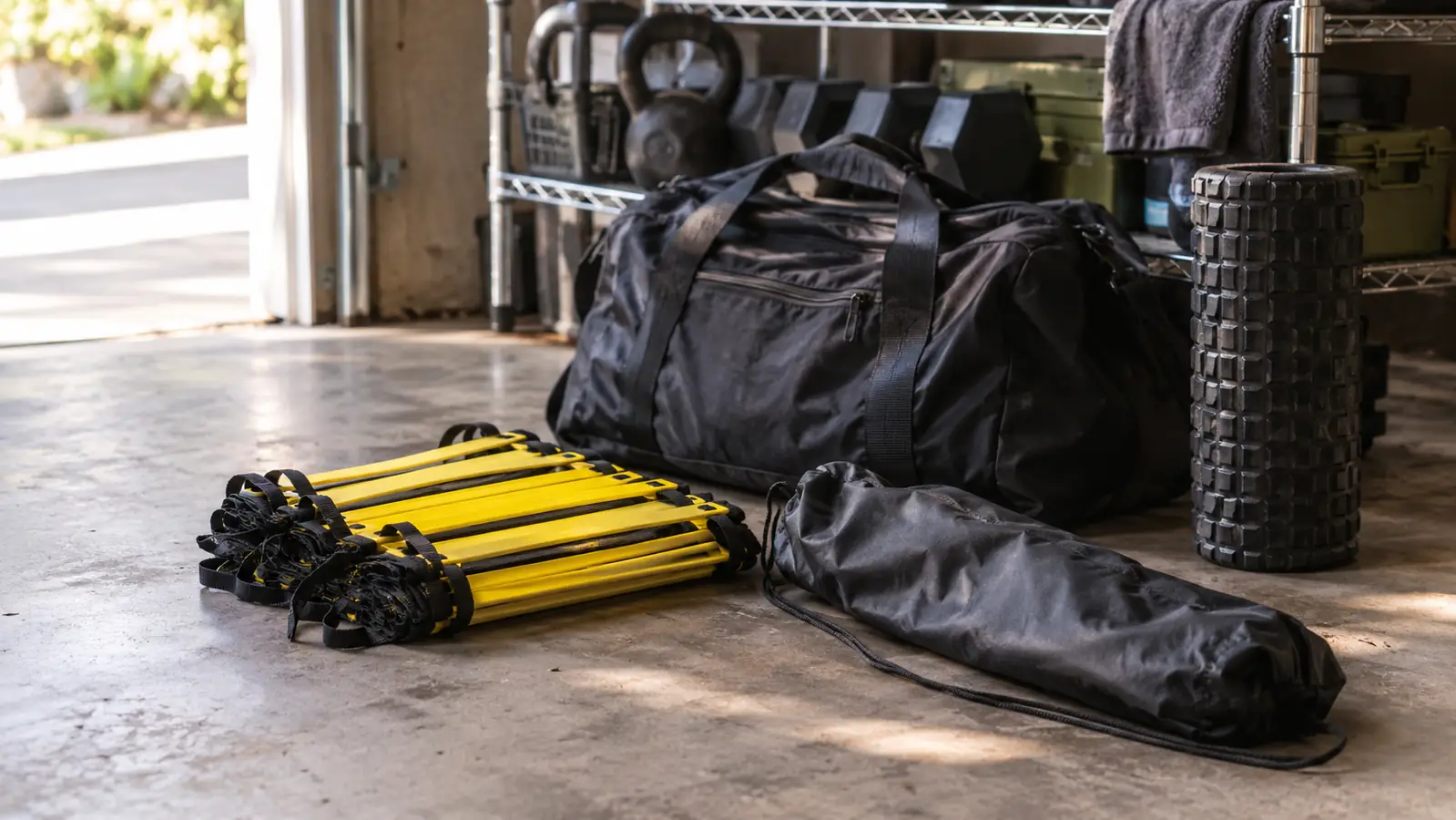
Gear that lives in a closet does not get used. That is the entire reason this ladder got seven months of use while other things I bought got two weeks. The one I train on sits on the wire shelf by the garage door, right next to the foam roller. The second one lives in the team bag and never comes out of it. Those are the two places I will actually see it, so those are the two places it stays.
The GHB ladder is not the most exciting thing on that shelf. It is not the most expensive either, and it is the one I would replace first if it broke. But it has not broken, it does a specific job well, and it cost me less patience than any program I have started and quit. If you are the type who needs a screen and a coach telling you what to do, this is not your tool. If you will lay it out on a Tuesday morning and put in ten honest minutes, it will hold up its end.
Ten minutes twice a week beats a program you never start
Two 20-foot ladders, 12 rungs each, spacing adjustable up to 15 inches, and a bag for each one. Check the spacing, lay it straight, and put in the work.
Amazon Check Today's Price on Amazon →