

Foot speed is not a gift you get at birth and keep for free. It is a skill, and like any skill it goes stale if you leave it alone for a few months. I am 46 years old, I caught for four years in college, and my knees file a formal complaint every time the weather changes. But I still play men's league basketball on Tuesday nights and softball in the spring and fall, and the gap between feeling quick and feeling like I am dragging a piano behind me comes down to about ten minutes of work, twice a week.
For the last seven months that work has been the GHB Pro Agility Ladder. I bought the 2-pack, laid one out on the driveway, and put the second one in the team bag for my son Tanner's travel baseball practices. Tanner is 14 and quicker than I ever was, which he brings up roughly daily. What follows is the routine I actually run, in the order I run it, including the parts most people skip and the parts that were a waste of my time.
The ladder that lives on my driveway, not in a closet
Twelve rungs, 20 feet, two ladders and a carrying bag so one can travel with the team. See today's price on Amazon and get the second one out of the garage.
Amazon Check Today's Price on Amazon →Step 1: Lay It Out Where You Will Walk Past It
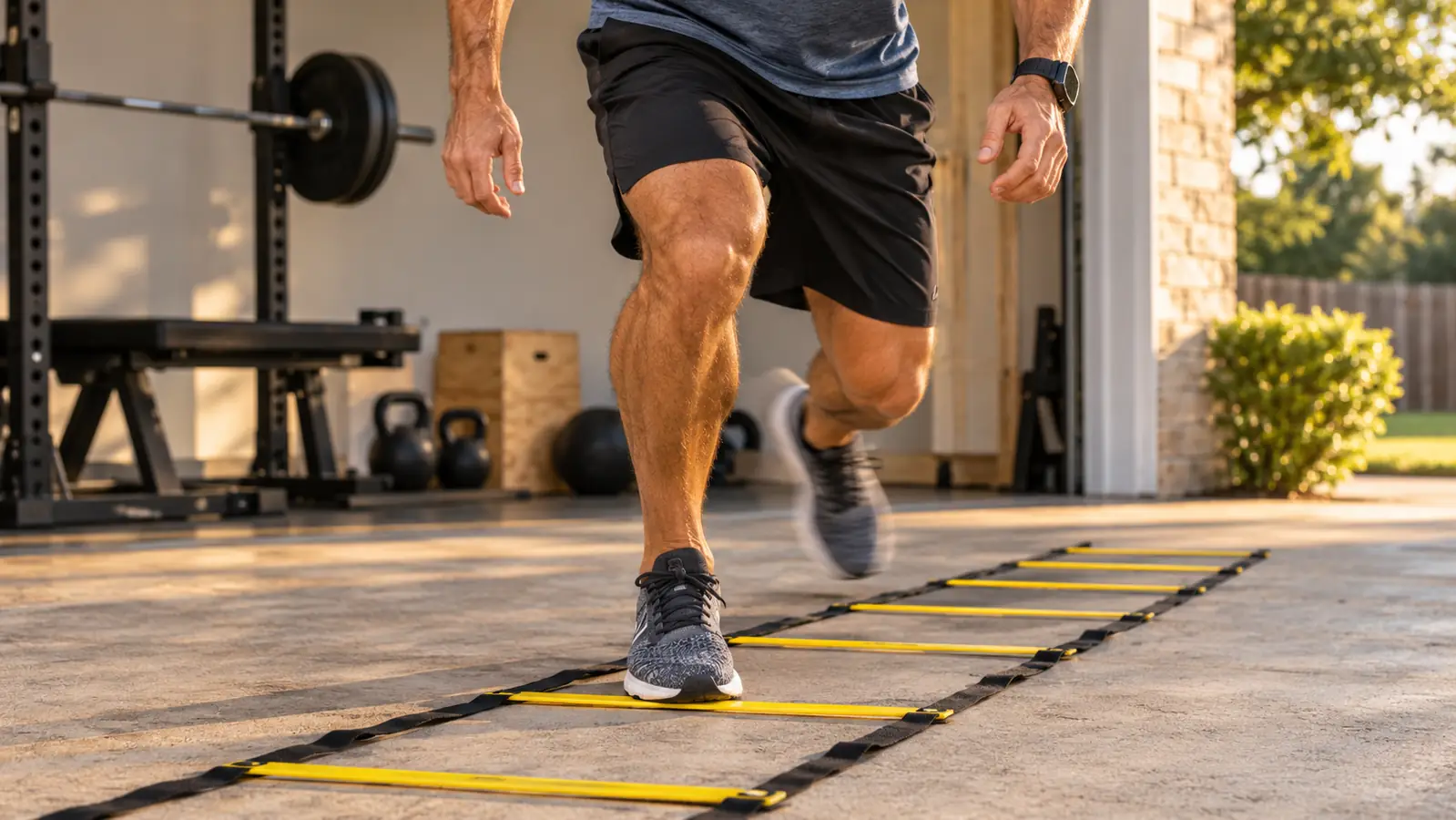
The best agility ladder is the one you trip over on the way to your truck. I have a two-car garage with a rubber mat, a squat rack and one pair of 35-pound dumbbells I have owned for about ten years, and for a long stretch that garage was where every training tool I bought went to die. The ladder sits on the driveway instead, right outside the garage door, and I leave it there during the week. Walking past it on the way to the F-150 is the entire accountability system. It is not clever. It works.
Set the spacing before you start moving, because the spacing changes the drill. The GHB ladder has 12 plastic rungs and runs 20 feet overall, and the space between rungs adjusts up to 15 inches. Wide spacing is slower and more forgiving. Tight spacing is faster and less forgiving, and it punishes lazy feet. I set mine roughly a foot apart, which is the range where the pattern still feels like a drill and not a game of Twister. Tanner sets his tighter. Start wider than you think you need, then tighten it once the pattern is clean.
Plastic rungs are fine on concrete and fine on turf, and on a dry driveway the thing stays put well enough that I am not chasing it. Wet concrete is a different story, so if it rained overnight, move it or wait until the afternoon. The whole ladder stuffs into the carrying bag that comes with it, which is how the second one travels to practices without turning into a bird's nest of straps in the back seat of the truck.
Step 2: Walk It Before You Run It
Everybody wants to sprint through the ladder on day one. That is how you learn sloppy feet, and sloppy feet at speed is just a bad habit with a stopwatch attached to it. For the first two weeks I walked the patterns. One foot in every box, then two feet in every box, at a pace that would have embarrassed a middle schooler. I did it in the morning before work with a cup of coffee still sitting on the tailgate. The first morning I tried to jog it cold, in January, on a 38-degree driveway, I clipped the third rung with my heel and about went over the tailgate. That was the whole lesson. Cold feet and a cold ladder do not mix, so now the walk happens before anything faster, every single time.
The point of the walk is foot placement. You want the ball of the foot landing in the middle of the box, not clipping a rung with your heel and not lunging to reach the next space. When you walk it, you can hear your own feet. When you sprint it, you cannot. That sound is the only feedback the ladder gives you, so use it while you can still hear it.
Two weeks is not a rule, it is what it took me. My right hamstring tightens up easily, going back to my catching days, and walking the pattern let me figure out that the tightness showed up when I overstrided, not when I went faster. If you are coming off a winter of doing nothing, give it three weeks. It costs you nothing but patience, and patience is a lot cheaper than a spring full of nagging tweaks.
Step 3: Pick Three Patterns and Stay With Them
There are about forty named ladder drills floating around the internet and maybe five of them are worth your time. I use three. One foot per box, forward. Two feet per box, forward. And a lateral in-out where you step in, step out, and work your way down the ladder sideways. That is the entire menu. I tried a fourth for a couple of weeks, an in-out forward pattern that looks great in a highlight clip, and dropped it because I could never find the rhythm without looking down at my feet. I run all three of mine on the GHB ladder at 12 rungs and 20 feet, which is long enough that a sloppy pattern shows up around rung eight whether you want it to or not.
The reason to stay with three is that the drill is not the point. The point is that your feet get clean, then they get fast, then they stay clean while tired. Bouncing between fifteen patterns means you never get past clumsy on any of them. Tanner's travel team runs the same three, and the kids who look sharpest at tryouts in February are usually the ones who drilled a short list in January instead of collecting drills off the internet.
Go down and back. That is one rep of the ladder at 20 feet, which is a longer run than it looks, especially sideways. Two reps per pattern when you are starting. Four when the movement feels automatic. If your feet start clicking rungs, that is the signal to end the rep, not to push through it. Clipping a rung is not a toughness test, it is a coordination error, and it gets worse the longer you keep going.
The weeks I skip the ladder, I feel it in the first five minutes of Tuesday basketball. The weeks I do not, I forget my knees are supposed to hurt.
Step 4: Put a Clock On It, Then Take the Clock Away
For the first month I timed the ladder. Not because the number matters to anybody but me, but because a clock keeps you honest about effort. A rep that feels fast and a rep that is fast are two different things at 46. I write the times on a notepad on the workbench in the garage. That sounds like more discipline than I actually have, but it is four numbers twice a week and it takes about ten seconds. The first timed session was ugly: 9.4 seconds down and back on the one-foot pattern, with two rung clips in the second rep. Six weeks later I was at 7.8 with clean feet, and the improvement was not fitness. It was that I stopped reaching.
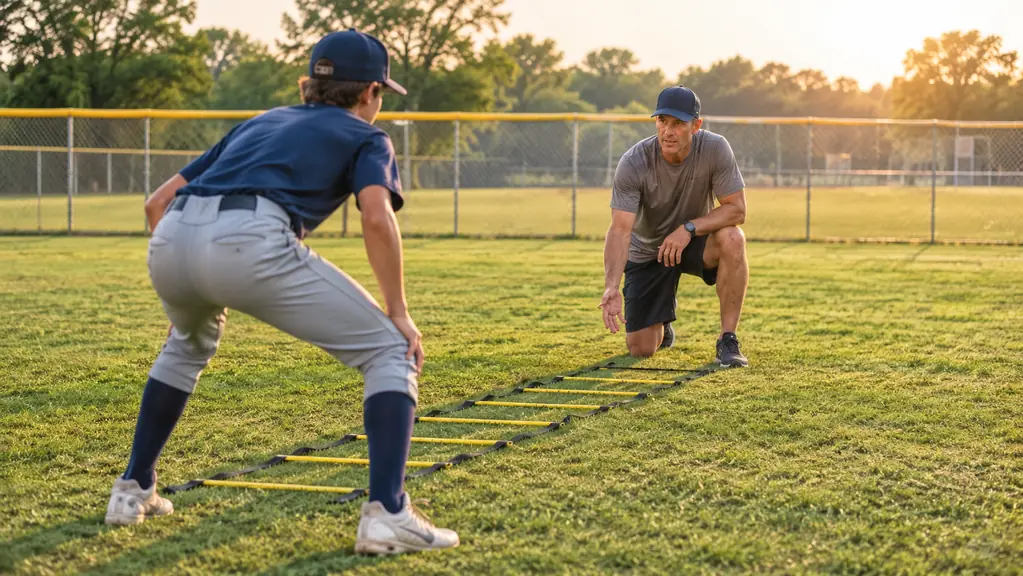
After a month, I dropped the clock and added a reaction cue instead. Tanner stands at the end and claps when he feels like it, and I start on the sound. That is not a gadget and it is not fancy, but it trains the part that actually matters, which is getting your feet reorganized after something unexpected happens. A catcher who has to reset his feet on a pitch in the dirt is doing the same job as a shortstop moving on a bad hop.
One honest caution. Fast feet on a ladder do not make you faster in a straight line. If your whole goal is a better 60-yard dash, this is a piece of the puzzle, not the puzzle. What the ladder does well is teach your feet to fire in sequence without you having to think about it, and that shows up in every sport I still play.
Step 5: Cap the Time and Walk Away
The routine I settled on is twice a week, eight to ten minutes total, done after a warmup and before anything else. That is it. The temptation is to keep going because it feels productive, and then you are doing twenty minutes of footwork on a Tuesday and wondering why your calves are mad at you on Wednesday. Short and repeatable beats long and occasional, every time.
Here is the honest limit. When your feet start landing flat, or your hips start rotating to cheat the pattern, you are done for the day. Not one more rep. The last rep of a set should look like the first one. If it does not, you are rehearsing the wrong thing at speed, and the ladder will happily let you do it without complaining once.
The other habit that helped was leaving it out. If the ladder is sitting on the driveway and I am walking to the truck, I will do two reps in my work boots. That is not a training session, it is a reminder to my feet that they have a job. Over seven months, the two-rep trips have probably added up to more quality touches than the sessions I actually planned did.
What Else Helps
The ladder is part of a warmup, not a replacement for one. Before I touch it, I spend about five minutes with a set of loop bands on my hips and glutes. I bought the cheap set two years ago after my hips felt locked up during softball warmups and I have not broken one yet. Five minutes with a band makes the ladder work feel smoother, and it makes my first sprint down the driveway less of an adventure. I do the same five minutes before men's league basketball on Tuesdays, mostly because the first time I skipped it I spent the next two days walking like a man who had been sitting in a car since Waco.
After the ladder and after whatever game I just played, I roll my hamstrings and upper back on the foam roller I keep on the wire shelf by the door. On basketball nights I use compression boots on the living room couch for 30 minutes while Dana watches something I am not paying attention to. None of that is complicated. It is just a routine that makes the next morning less stiff. If something hurts in a way that does not ease up in a few days, that is a doctor conversation, not a ladder conversation. I am an assistant athletic director, not a physical therapist, and I am not going to pretend otherwise.
One more note on the 2-pack, since it is the reason I bought this one over a single ladder. The one on my driveway has taken seven months of concrete and weather and it is still holding up, and the manufacturer lists a two-year warranty on it. The second ladder lives in the team bag and gets dragged to two practices a week by a bunch of 14-year-olds, which is a harder life than mine. If you only train yourself, one is plenty. If you coach, get the pair.
Two ladders, one bag, ten minutes twice a week
Twelve rungs per ladder, 20 feet overall, rung spacing adjustable up to 15 inches, and a carrying bag for the one that travels. Check today's price on Amazon.
Amazon See Today's Price on Amazon →