

Last winter I got out of bed on a Wednesday morning, put my right foot down, and felt the back of my thigh pull like a wet rope. I am 46 years old, I still play men's league basketball on Tuesday nights, and for the next three days I walked the halls at school like a man twice my age. Nothing was torn. There was no pop, no bruise, no swelling. My right hamstring was just tight, and it had been tight for years, and I had been ignoring it the same way I ignore the oil change light in my truck.
It was not a stretch that fixed it. It was a foam roller. Specifically, it was the TRIGGERPOINT GRID I bought about three years ago, after a physical therapist friend watched me try to touch my toes in the dugout and told me to quit doing that. For two of those three years I used it on my upper back and my IT band area and basically nowhere else. Once I started putting my hamstrings on it most mornings, the Wednesday walk got easier. Not overnight. Over about six weeks.
The roller I reach for before my coffee, not after my first setback
The TRIGGERPOINT GRID is 13 inches long and 5.5 inches across, with a multi-density foam exterior built over a rigid hollow core. It is rated extra firm and carries a 500 pound weight limit. Three years on the same one, in a garage that hits triple digits in August, and it has not gone soft or lost its shape. 4.7 stars across 23,790 ratings and a one year limited manufacturer warranty.
Amazon Check Today's Price on Amazon →Why Hamstrings Stay Tight in the First Place
Short version, and I am not a trainer, a physical therapist or a doctor, so take this as one guy who has spent a lot of time on the floor of his garage. The hamstring runs from your sit bone down past the back of your knee. It got worked for four years of college baseball behind the plate, then for a couple of decades of Tuesday night basketball with no maintenance in between. Tight is what a muscle does when it gets loaded and never gets any blood moved through it outside of the loading.
The other part is that tight does not always mean short. Sometimes a hamstring feels tight because it is guarding, or because something above it at the hip or below it at the ankle is not doing its job. That is why thirty seconds of static stretching felt like nothing to me. I could get into the stretch. I just could not keep it, and by the next morning it was back where it started.
What rolling does well is put direct, controlled pressure on one specific spot while you move. It takes five minutes, it happens on a rubber mat in a garage at 6 a.m. in gym shorts, and you do not need a partner or a table. That is the whole case for it, and for me it was enough.
Step 1: Find the Tight Spot Before You Roll
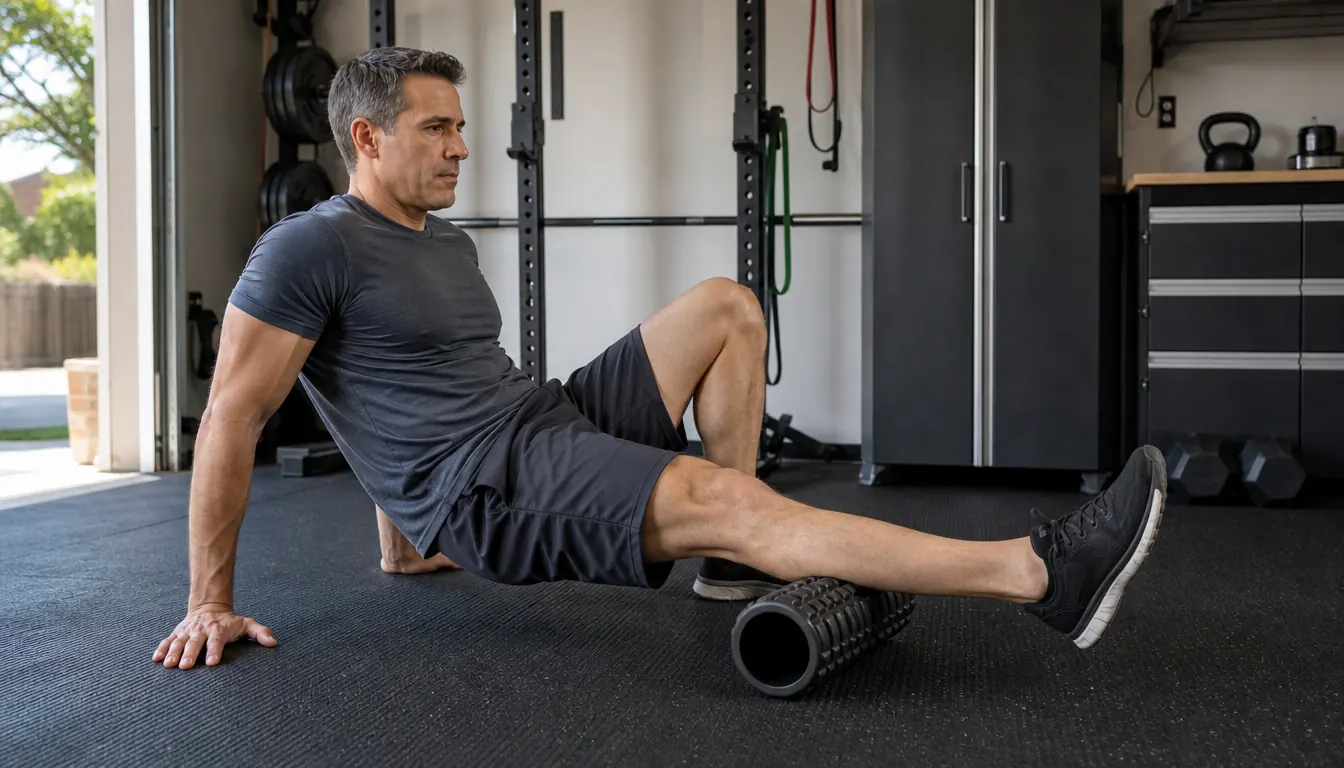
Do not start by hammering the muscle. Start by finding out which part of it is actually talking to you. Sit on the floor with the roller under one thigh, both hands braced behind you, and move slowly from the crease of your glute down to about two inches above the back of your knee. You are looking for the two or three spots that make you hold your breath.
For me it is the outer half of the right hamstring about a hand's width above the knee, plus a second spot right up near the sit bone. The left side barely reacts to anything. That difference has held for three years, and it tells me where to spend my time instead of spreading it evenly over the whole leg.
If you cannot tell where it is tight, note it in your phone after the first pass and check again in a week. Most people can feel the difference once they are actually looking for it. Rolling the whole muscle evenly and hoping something changes is how you waste a month.
Step 2: Get Into a Position You Can Actually Hold
The setup matters more than people think. Sit on the mat, put the roller under one thigh, plant the other foot flat on the floor, and lean back on your hands. Lift your hips just enough that your weight is on the roller and your hands together. If your arms are doing all the work, you will quit in twenty seconds and blame the roller.
The GRID is 5.5 inches across, which is on the larger side for a foam roller, and for a hamstring that is a good thing. It does not sink into the muscle and disappear. The multi-density exterior over the rigid hollow core keeps the pressure where you put it rather than spreading it out over the whole back of the leg.
If it is too much on day one, keep both feet on the floor and roll both legs at once, or let your hands take more of your weight. Nobody hands out a trophy for going full body weight on the first session. My first two weeks were one leg taking maybe half my weight, and that was plenty.
Step 3: Roll Slow and Short, Not Fast and Long
The mistake I made for the first month was rolling fast, like I was trying to sand a board. Fast rolling mostly just wakes the muscle up and leaves it exactly as tight as it was. Slow rolling is the part that changes how the leg feels the next morning.
Go about an inch per second. When you find a spot that gets your attention, stop on it and breathe for twenty to thirty seconds, then move on. Total time on one leg should be a minute, maybe ninety seconds. That is the whole session. More is not better here, and grinding on one spot for five minutes will leave you sore in a way that has nothing to do with the original problem.
Skip the back of the knee. Skip the bony point at the sit bone. Roll the meat of the muscle, not the joint. And if a spot feels sharp or electric rather than like a deep ache, come off it. That is not a spot to work through, that is a spot to leave alone.
Step 4: Work Both Ends of the Muscle
Almost everybody rolls the middle of the hamstring, because the middle is the part that feels good and produces that satisfying ache. The ends are where I get the most out of it, and the ends are what I skipped for two years.
Higher up, slide the roller until it sits just under the fold of your glute, turn your hips slightly, and work a short arc there. Lower down, slide it to about two inches above the back of your knee and make short passes with the knee slowly bending and straightening. Those two spots are exactly where mine locks up after a night of basketball, and they are the two spots that made the biggest difference once I started hitting them on purpose.
Same 13-inch TRIGGERPOINT GRID for three years, in a garage that hits triple digits in August, and it has not gone soft or lost its shape.
There is nothing fancy about that. It is foam over a hollow core, and the density is the part that matters. A soft roller on a tight hamstring feels nice and does nothing. The extra firm one is not comfortable, and comfortable is not the job.
Step 5: Move On It, Then Finish With a Real Stretch
Once a spot has calmed down, add movement. With the roller under your thigh, slowly bend and straighten the knee ten times while keeping the pressure on the same spot. That is what separates rolling from lying on the floor with a foam tube under you. The muscle is being asked to work while it is under pressure, and that is the part that seems to stick.
Then stretch, and stretch after, not before. Thirty seconds on the back of the thigh, then switch sides. Now that the muscle has had pressure and some blood moved through it, the stretch actually holds for me. Before rolling, it did not. I could get into the position and it would slide right back out by the time I stood up.
How often: most mornings. Five minutes total, both legs, calves if I have time. I do it on the rubber mat with the garage door open before I go in for coffee. When I skip two or three days in a row, I can feel it by Wednesday, and that is the most reliable feedback I get.
How Long It Took Before I Felt a Difference
First week, not much. My hamstring was sore in a different way than before, which I took as a great sign and probably over-read. Second week, the morning walk to the mailbox stopped being a negotiation. Third and fourth week, I could put my heel down flat getting out of bed without leaning on the dresser. That was the first change I actually believed.
By the end of six weeks, the Wednesday after basketball was a normal day instead of a recovery day. That is not a dramatic story. It is a 46 year old man who stopped losing two days a week to a tight leg. But it is the reason the roller still lives on the wire shelf by the door to the house instead of in a bin in the attic.
I still get tight. When I skip a week, or when I sit in the truck too long on a Friday, the right side reminds me. The difference is that now I know what to do about it, and it costs me five minutes instead of a week of complaining to whoever is standing nearby.

What Else Helps
The roller is one tool and it is not the whole answer. The other thing that helped was warming up before I do anything, not after. Two minutes with a band around my knees, a few bodyweight squats, and a walk around the block before basketball beats anything I do once the game is over. I learned that one late.
After a game, the compression boots get 30 minutes on the couch two or three nights a week. That is a much bigger commitment and I would not tell you to start there. The roller came first for a reason, and if I only had one thing, it would be the roller.
Sleep, water, and not sitting in a truck for three hours after a game matter too. I drive a gray 2018 Ford F-150 and that seat does my hamstrings no favors on a long Friday. That is not a roller problem. That is a get out and walk around problem, and no piece of gear fixes it.
And the one that matters most: if the pain comes with a pop, a bruise, swelling, or you cannot put weight on the leg, that is a doctor visit, not a foam roller. Rolling a torn hamstring is a bad idea and I would hate for anybody to read this and try it. I got lucky. I also got careful.
Five minutes on the garage floor, most mornings, is the entire program
The TRIGGERPOINT GRID has been on my shelf for three years. 13 inches long, 5.5 inches across, extra firm, rigid hollow core, 500 pound weight limit, one year limited manufacturer warranty. It also comes with access to a free online instructional video library from TRIGGERPOINT if you would rather watch the technique than read it.
Amazon Check Today's Price on Amazon →